Who built Vero Beach’s free dog park? The answer is in the fence, the benches and the driveway
A city lease, private donations and community volunteers turned five acres into Vero Beach Dog Park. The early spending records reveal what a public park really needs.
The largest single entry on an early list of improvements at the Vero Beach Dog Park was for a driveway and accessible parking. Fencing came next, followed closely by trees and landscaping. The list is an unexpectedly good history of what it takes to establish an off-leash area. Before it can be a place for a dog to run, it has to be somewhere people can get to, enter, navigate and look after. A drinking fountain, shade, a bench and an accessible approach all register in the accounts long before anyone tries to reckon the value of an afternoon at the park.
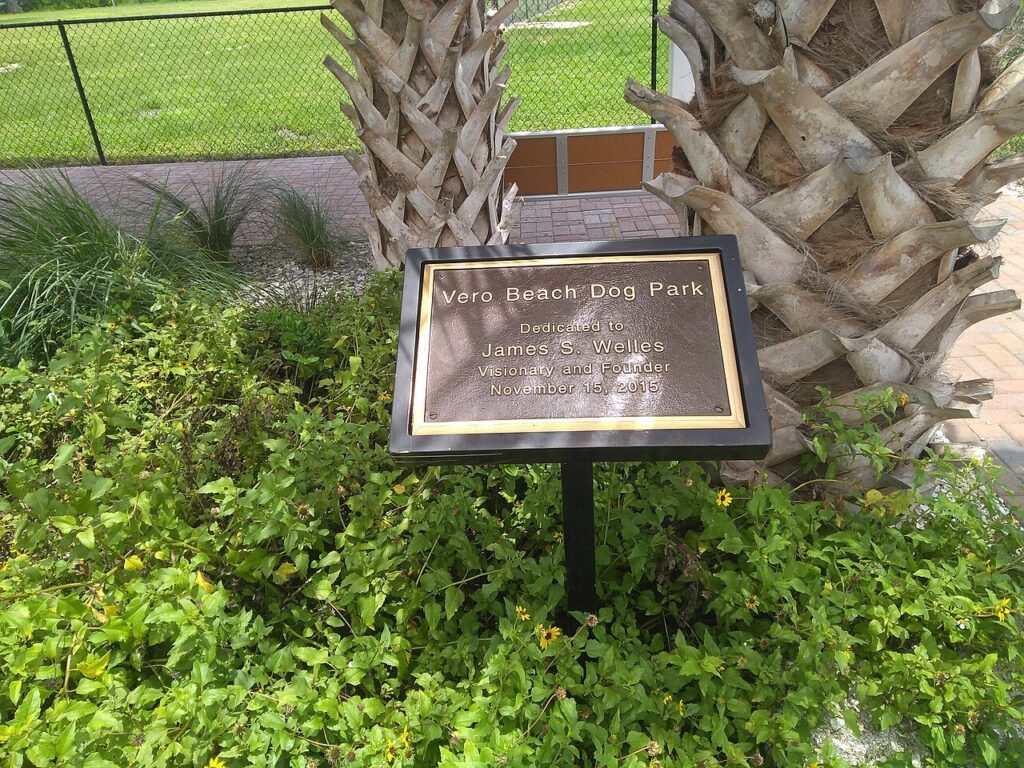
The city’s original agreement with the organization behind the dog park dates to 2014. It permitted development of about five acres in Alex Mac William Park. The nonprofit identifies founder Jim Welles as the person who proposed leasing the land from the city, and credits a volunteer board and community with the work that followed. A memorial to James S. Welles at the park gives a name to an idea that became a daily part of life for local dog owners. The park is free to visit. Its development and ongoing care have relied on donations and volunteer effort. City lease and improvements record · Park organization’s account
The first five years in ordinary objects
A 2019 staff memorandum to Vero Beach's city manager attached a summary of capital improvements from March 2014 through February 2019. It listed $197,892 in expenditures and specifically excluded donated materials and labor from that figure. This is an important qualification. The dollar amount records money spent by that date. It does not place a price on all the time or goods supplied by people living nearby. Nor is it a statement of what the park costs to run today. It is a dated snapshot of a community converting an idea into a usable place.
The total included $56,904 for the driveway and accessible parking areas and $32,148 for fencing. The categories answer different needs. Someone may reach a park with a dog that is ready to run but still need a manageable route from the car to the gate. Inside, the ability to let dogs move freely depends on a deliberate boundary. The first investment gets people to the space. The second helps define what the space is for. Neither has the visual appeal of a group of dogs playing, but both are fundamental to the photograph people eventually take.
The improvement list also included spending on wells and irrigation, walking surfaces, shade and benches. Some work is visible every time a visitor arrives. Other spending is easiest to notice only when a system needs attention. A tree planted for shade needs a way to become established. A bench becomes much more useful when the route to it works for a visitor who cannot cross uneven ground comfortably. Read the figures together and the project begins to look like landscape design and maintenance as much as animal recreation. That is often how neighborhood projects work once a good idea becomes a daily responsibility.
How a free park pays for its next repair
The Vero Beach Dog Park organization describes a volunteer board and reliance on community donations. Free entry and ongoing expenses coexist because visitors do not have to pay for a separate ticket every time someone uses the space. Instead, people can contribute money or time toward shared facilities. A person considering support can ask whether a particular need concerns routine upkeep or a new project. Money for a replacement part and money for an additional amenity can have equally important but different effects on the quality of the park. Park history · Donation information
The arrangement involves two institutional roles. The municipal agreement concerns the land and authorization to use it. The nonprofit handles the local work described on its site. Someone trying to report an issue about an ordinary visit should therefore start with the park's own contact or incident process. A resident asking about the history of the land arrangement can read the city's record. The 2019 packet includes a proposed extension and related documents. It is useful as evidence of what city staff sought and what work had been done, without assuming that every detail in a proposed agreement describes present-day conditions.
Rules that keep a shared space usable
For a first visit, the park gives its physical location as 3449 Indian River Drive East. Its separate mailing address on Beachland Boulevard is for correspondence. Programming the wrong one into a navigation app will take a driver to a different errand entirely. The posted rules identify a small-dog area for dogs of thirty pounds or less and set a limit of three dogs per person. They also exclude people food, pet food, dog treats and glass containers. These are local operating rules, so check the park's version before arriving rather than relying on custom at another dog park. Park location · Posted rules
The organization offers an incident or comment form that asks which area was involved. That small question illustrates how a working park is managed. A general report saying something happened “at the dog park” gives a volunteer little to go on. Naming the area, time and what was actually observed gives the operator usable information. The same discipline helps with a maintenance concern. A description of where a gate or other feature is located allows someone to inspect the right place. The visitor contributes to upkeep by supplying a clear observation, even if they never attend a board meeting.
Consider the improvements from the point of view of two neighbors, one coming every morning and another visiting only occasionally. Both need a working gate and a clear route into the park. A contribution from either goes into a space that remains available to the other, a small but concrete expression of shared ownership in its upkeep.
A first-time visitor may remember a friendly conversation, the view by the lagoon or the first moment a dog found room to run. Those experiences do not appear anywhere in a capital improvements ledger. The driveway, the fence and the benches do. Looking at both accounts together explains why the plaque honoring Welles belongs here. He helped start an arrangement in which many people, contributing different kinds of work, could give a neighborhood something each of them could use without an admission charge. An ordinary visit is the outcome the unglamorous numbers describe.