The People Who Kept Pelican Island on the Map
Local volunteers helped restore a disappearing island off Sebastian. See how that work began, what the boardwalk records and where new volunteers can help.
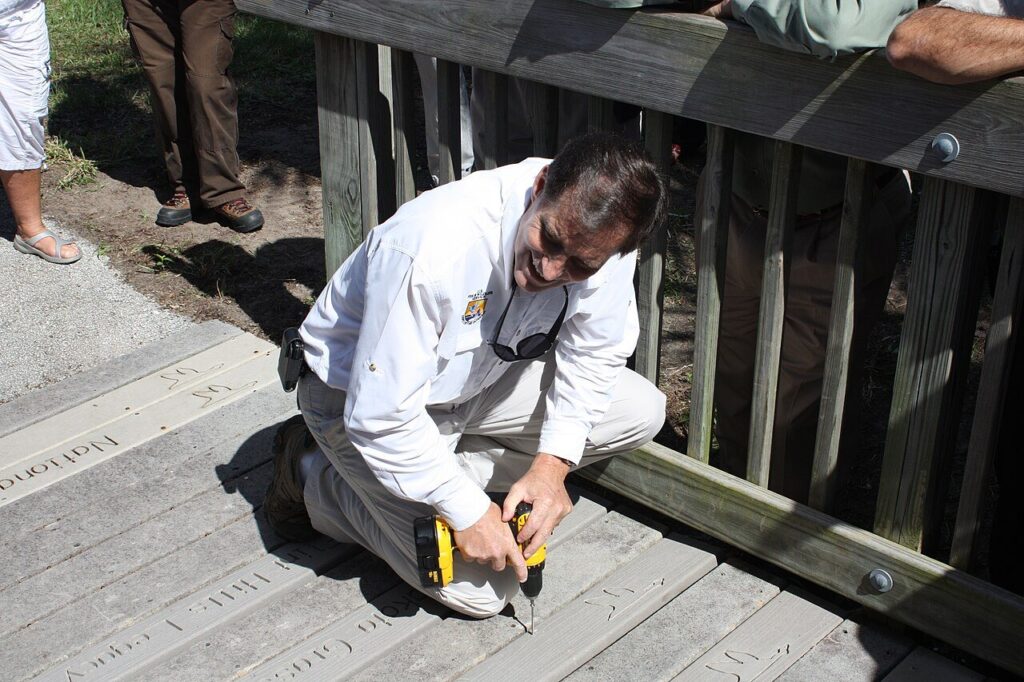
In an October 2011 photograph from Pelican Island, Dan Ashe bends to install a plank in a boardwalk. Most decks would look much the same after the addition of one board. This one keeps a national register beneath the feet of people walking out to look at birds. Each engraved plank identifies a wildlife refuge, its state or territory and the year of its founding. Finish the walk and the dates take you back to 1903 and an island off Sebastian. Getting a name into timber is one achievement. Keeping the place it names above water took an altogether different set of hands.
The two undertakings unfolded side by side. While public agencies and local partners planned a trail for the refuge system’s hundredth birthday, people here faced the possibility that the physical island at the center of the celebration might disappear. In the Conservation Society’s account, the island had shrunk from five and a half acres to just over two by 1999. President Theodore Roosevelt’s signature still protected the rookery on paper. It took oyster shell, plants, money and people willing to work together to do something about the shoreline. The society’s remembrance of Walt Stieglitz records what local volunteers contributed.
A friends group grows out of a birthday
In 1993 residents helped put together a ninetieth birthday party for the refuge. It became the first Pelican Island Wildlife Festival. The organizers could have folded their tables and met again ten years later for the bigger anniversary. Instead, they established a group that could keep raising money, explaining the refuge to neighbors and speaking for it at public meetings. Its original name, the Pelican Island Preservation Society, accounts for the initials PIPS in older accounts. Today it is the Pelican Island Conservation Society. The group’s organizational history traces that change and its continuing partnership with the refuge.
Stieglitz, elected president of the friends group in 1997, took on tasks with remarkably different demands. Removing invasive vegetation from a refuge impoundment required people prepared to work outside. Persuading a roomful of county officials that development could affect a nearby rookery called for research, allies and someone willing to testify. The group’s remembrance describes him doing both. He helped organize opposition when owners of four neighboring citrus properties entered into agreements with developers. As plans shifted from opposing development to acquiring land, supporters had to make a case for federal dollars. A signature on a petition and a line in an appropriations bill represented different stages of the same local effort.
What volunteers planted
At the island itself the immediate problem was erosion. The Fish and Wildlife Service describes a project built around a 165-foot wave break made of oyster shell. Crews brought in the material by helicopter to limit disturbance to the birds. Behind that protection, smooth cordgrass and mangroves could help catch sediment as water moved across the shoreline. A barrier could soften wave action, but the project also depended on living plants taking hold. According to the friends group’s account, it provided volunteers to plant the shoreline and contributed $13,000 to the work. The agency’s history of the refuge explains how partners put the engineering pieces together.
Those details change the picture from the observation tower. What looks like an undisturbed island from across the lagoon owes part of its outline to people who moved shell through the air and pressed vegetation into the shore. It also puts a limit on what a visitor can infer from a famous photograph. A board going into the viewing deck records a public occasion. The little edge of vegetation out in the water records years of work, with few names in sight. Both belong in an account of what this community built.
A place to interpret the work
The Centennial Trail opened on March 14, 2003, a century to the day after the federal bird reservation was established. The Department of the Interior recorded Secretary Gale Norton installing the final plank for the dedication. Eight years later, Fish and Wildlife photographer Kevin Lowry documented Ashe installing another. The two images of public officials at work belong to different occasions. Read alongside one another, they explain why the deck reads like a continuing history. The centennial recorded a hundred years of places set aside for wildlife, and the national system kept growing. The 2003 dedication account and Lowry’s 2011 photograph give the dates.
That timeline makes a practical tool for a volunteer speaking with a family. A child can look for a familiar state among the planks. An adult who remembers visiting another refuge can look for its name and see where its date falls relative to Pelican Island. A visitor eager to see the original protected ground can follow the deck to a mounted scope. Each can ask a different question of the same place. At the Centennial trailhead on Jungle Trail, the local society lists Friday volunteer meet-and-greets from 10:30 a.m. to 1:30 p.m. Check the society’s current visiting information before making a special trip to speak with someone.
Two ways to join in
People interested in federal refuge service can start with the volunteer coordinator at Pelican Island. The agency describes introductory training and assignments that depend on the season, available work and the volunteer’s skills. Its examples include maintaining equipment or grounds, helping in the office, assisting with specific habitat projects and talking with visitors. Someone who enjoys explaining the boardwalk may have a very different first assignment from a neighbor with mechanical experience. Describe both your skills and the days you can actually be there when contacting the refuge. The federal refuge page lists its contact details and the correct trailhead at 11455 Jungle Trail.
The Conservation Society has a separate volunteer form for its own work. It asks for help staffing information tables at local fairs and markets, serving on committees and putting on the wildlife festival. A person with a single free weekend can ask about working before, during or after an event. Someone who wants a longer commitment can ask about education, advocacy or fundraising. That is how a conversation starting miles from the water can still serve the rookery. A volunteer who knows the story of the shell and the cordgrass can explain exactly where a past contribution went. The society’s volunteer form puts that offer in front of its coordinator.