Why Gifford’s School Gym Bears the Name of Coach Jake Taylor
Two Gifford High basketball titles and a Vero Beach girls state final help explain the name on the gym where Gifford Middle School athletes gather today.
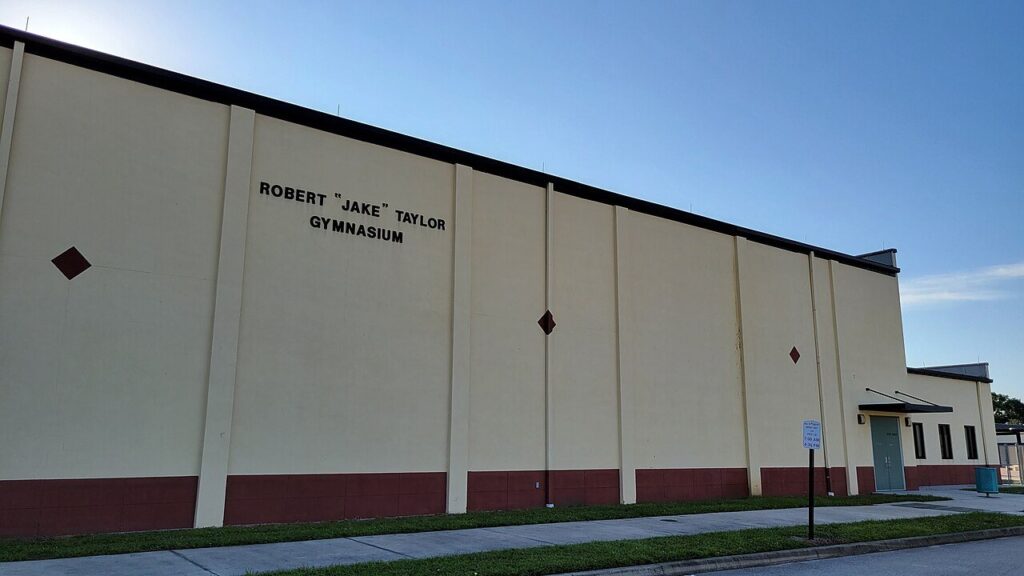
Take the name over the gym at Gifford Middle School and look it up in the Florida girls basketball record book. The trail leads away from Gifford, to a state final in Winter Park in 1985. The winning coach is Sheila Rush of American High School in Hialeah. Across from her is Robert J. Taylor of Vero Beach, whose team finished second. Read the old boys basketball records and the trail leads home again, to two championship teams at Gifford High. One man’s career joins those three entries. Today a sixth grader who has yet to play a school game can find his name by following the directions to tryouts.
The distinction between the high school and the middle school matters in Gifford. They occupy the same address in different eras. The championship teams played for a Black high school under segregation. The public school now at 4530 28th Court enrolls sixth through eighth graders. The gym’s dedication to Robert “Jake” Taylor gives a young athlete a place to start asking how those two institutions are related. The answer also runs through a donated piece of land, the class gift of a sundial and a page in the state record book that is easy to miss.
Find the right championship table
Turn to the Florida Interscholastic Athletic Association champions in the state boys basketball record book. In 1952 Gifford High appears under Class B. In 1965 it appears again, under B South. In the second year the same table lists a different B North champion, Dunbar High of Green Cove Springs. Those headings matter. They identify the competitions Gifford won and explain how two schools can point to a basketball championship in the same year and nominal class.
For much of Taylor’s coaching career, Black secondary schools in Florida competed in their own statewide association. It consolidated with the organization governing other high school athletics in 1968. The governing body’s profile of its former executive secretary Wilts Alexander explains the merger and Alexander’s work bringing the two programs together. A search that stops at the first championship table can skip Gifford’s record entirely. For a family doing a school project, there is another trap. Searching only for Vero Beach, the mailing address on today’s school website, misses the entries filed under Gifford’s own name.
In his TCPalm column on the Treasure Coast’s championship history, Dennis Jacob identified Taylor’s distinct roles in those two victories. He was an assistant on the 1952 team and head coach in 1965. Thirteen years separated the championships. Twenty more passed before Taylor’s Vero Beach girls reached the state final. The girls record book shows a four-point win over Washington of Pensacola in the semifinal and a 51–39 loss to American in the title game. Taylor’s players reached the last game of the tournament with a different school and in a different era of Florida basketball. The state girls championship results identify the coach formally as Robert J. Taylor.
The state books also preserve two of Gifford’s last tournament runs. In 1968 its boys scored 95 points against Monsignor Pace of Miami in a regional final before losing to Wymore Tech in the state semifinal. In 1969, the year of the last graduating class, Union Academy of Bartow edged Gifford by four in a regional semifinal. Neither game appears in the short list of champions. Both document a team still competing under the Gifford name in the final years of the high school, with opponents from well beyond Indian River County.
What survived the high school
Long before Gifford could field a high school championship team, older Black students from the community had to travel to Fort Pierce to continue their studies. William Edward Geoffrey, a Black railroad worker who came to the area from South Carolina, bought eighty acres in Gifford in 1901 and gave part of the property for a school and park. The early school taught the elementary grades. High school grades came in 1938. A later historic resources survey for Vero Beach describes Gifford High as the county’s principal institution for the education of Black students. The county school board financed a new high school building at 45th Street and 28th Court in 1952, the same year that Gifford won its first boys basketball title.
The class of 1964 gave the school a sundial. A year later came Taylor’s second championship. Four years after that the school graduated its final high school class as Indian River County schools integrated. The state’s Gifford High School Sundial Landmark record identifies the sundial and façade as surviving pieces of the old high school. The name on today’s gym honors the coach. The marker gives a different account of what material evidence remains from the high school’s life. Put the two together and there is no need to assume that the lettering on a present-day building dates its construction to a championship year.
The county library offers another way to look at the campus without entering a working middle school. Its picture-file index identifies an item about the Gifford High School gymnasium dated August 22, 1957. Nearby entries concern the band, the last graduating class and a reunion. The index identifies material to ask the archive about. It gives a reader looking for the old gym a precise date and subject to bring to a librarian, without assuming what the actual photograph will show. A family photograph with a handwritten year on the back may fit into a much larger set of records.
The gym still tells students where to meet
In August 2026, Gifford directed students trying out for girls volleyball and coed soccer to the gym after school. Soccer players were asked to bring cleats and shin guards. Volleyball players needed court shoes, knee pads and water. All needed their physical and consent forms on file before trying out. That single meeting point served students bound for quite different playing surfaces. The school’s fall notice shows what a family needed for those sessions and why checking the instructions for a particular sport matters before buying equipment.
By November the school was arranging the basketball calendar. A revised notice put boys tryouts on November 9, 10 and 12, with girls practice beginning after the boys’ session on November 9. The break in the middle of the week reflected the school holiday on November 11. For the next game or tryout, the date to use is the latest one published for that team. The Gifford school feed carries updates, and families can reach the school at 772-564-3550 for directions or participation questions. A new player reading that notice has a straightforward task, finding the gym on time. For a relative in the stands who remembers the high school, the same destination carries a much longer memory.