Who surfed Sebastian Inlet first? Even the people who were there left room for doubt
Surfers’ recollections, archival images and a wave study tell different parts of Sebastian Inlet’s history, from a disputed 1959 first ride to First Peak’s fame.
A local sports story can be true in one sense and still leave its best question open. Dick Catri and Jack Murphy surfed Sebastian Inlet in 1959, according to a much-repeated account. Were they the first? The Florida Surf Museum treats that question more carefully than a commemorative slogan would. It compares accounts recorded years apart and notices a revealing detail: one recollection mentions local surfers who already knew about the place. If someone had directed the visitors toward the waves, perhaps the later visitors were the first to tell the story widely rather than the first to ride there.
The distinction is especially interesting at Sebastian Inlet, a place known well beyond Florida surf circles. The named break First Peak became associated with generations of East Coast surfers and with the unusual conditions beside the north jetty. A person arriving today might reasonably hear three questions folded into one: who first surfed the inlet, what made a particular wave famous and whether that wave still behaves as an older surfer remembers. Oral history, coastal engineering and photographs can all contribute. None answers all three questions on its own. Florida Surf Museum’s comparison of recollections
A story told twice
The museum juxtaposes Catri's account recorded in 1979 with information Murphy supplied through correspondence in 2018. Both concern events decades earlier. One person's memory can preserve a precise detail about getting to the inlet while simplifying who else might already have been there. Another can recall being told of good surf without identifying everyone involved. Old testimony is valuable precisely because it records things that seldom make their way into administrative files. Nobody had to fill out a government form before telling friends about a wave. That also means a claim about the first-ever surfer needs more than a memorable account of a very early ride.
The geography of the 1959 account is different from the familiar drive across the inlet bridge. Murphy recalled a time before the bridge was built, with A1A ending near a small fishing settlement. That practical detail changes the atmosphere of the story. An arrival remembered as a journey to an uncertain destination cannot be reduced to a modern navigation pin and a parking lot. It also helps explain why local knowledge would have mattered. A person who lived or fished nearby could recognize a wave pattern and pass it on without ever becoming a prominent name in the later history of the sport.
For a young reader working on a school or family history, the responsible conclusion is also the most interesting. Name the early surfers for whom there is testimony. Say when the story was later recorded. Preserve the possibility that local people had already surfed there. These are not evasions. They are ways of showing the reader exactly how much the surviving evidence supports. A dated photograph by itself would establish that somebody was there by that date, still leaving open what happened before the camera arrived. Historical priority is harder to prove than participation.
What the jetty contributed
The First Peak name belongs to a more particular story about breaking waves. A technical paper on the north jetty describes an interaction among incoming waves, reflection, the effect of shallowing water and changes in wave direction. The authors observed reflected patterns near the structure and explain why reflection mattered to the distinctive break. That account gives a nonsurfer something more substantial to imagine than a very large wave. A passing swell encounters an engineered structure and a changing bottom. The shape that develops near shore reflects several processes happening together. First Peak wave study
An analogy from watching ripples at an ordinary pond is useful up to a point. A line of ripples reaching a hard edge can come back across approaching ripples and create a visible pattern. At Sebastian Inlet there is much more going on than that simple demonstration. The water changes depth, the ocean brings waves of different periods and directions, and the jetty is a particular built structure, not a straight wall in a shallow tray. The study's authors explicitly discuss the limits of explaining the break by simply adding one approaching wave and one reflected wave together. That complexity is why memories of a famous break can outlast the conditions that produced it.
Surfer magazine's retrospective associates the inlet with surfers including Kelly Slater, Lisa Andersen and C. J. Hobgood, and describes changes following work on the jetty in the early 2000s. Read that as sporting history rather than a daily report of present surf conditions. An engineered inlet can keep its name while the shape of its waves changes over time. An older competitor's description of a particular ride may be completely sincere and quite unhelpful as a forecast for a visitor who arrives on an unrelated day years later. Surfing retrospective
A sporting landscape with several witnesses
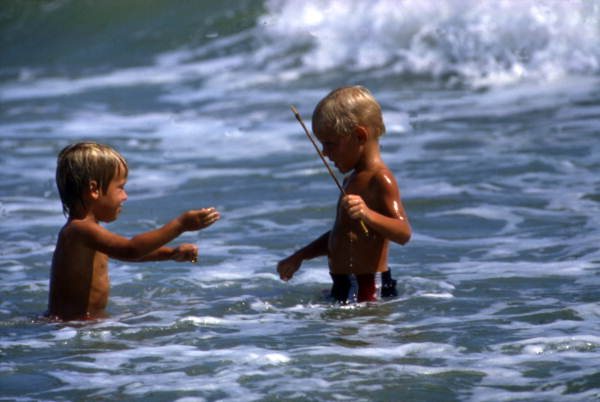
An archival image of young people in the surf records yet another layer of the place. Formal competition can produce results, rankings and widely circulated photographs of named athletes. Ordinary days at the water often leave only a family memory or a caption that identifies the site without naming everyone pictured. When looking at an image, resist the temptation to turn every person in the water into one of the famous early surfers. A photograph is evidence for what its details and reliable caption can show. It can also be a moving record of recreation without documenting a record-breaking ride.
Even a surf-spot name should be recorded with care. Someone who remembers surfing inside the inlet is locating the experience differently from someone describing a wave beside the ocean jetty. Keeping the witness’s own location language alongside the approximate date helps prevent an early memory from being assigned to a later named break.
The state park describes surfing as one part of a coastal landscape also known for fishing and other uses. A visitor interested in the history can observe from permitted public areas and check current park information before traveling. The inlet's appeal as a historical subject does not depend on trying to recreate someone else's experience in the water. A look at the jetty can start a conversation about engineering. A look at an old photograph can prompt a question about access. And two surfers' different memories can turn an apparent dispute about first place into an invitation to ask who else knew the coast. State park history