The ballpark that grew out of a Vero Beach air station
Trace Holman Stadium from a former naval air station through integrated spring training, the struggle over spectator seating and a new chapter in youth baseball.
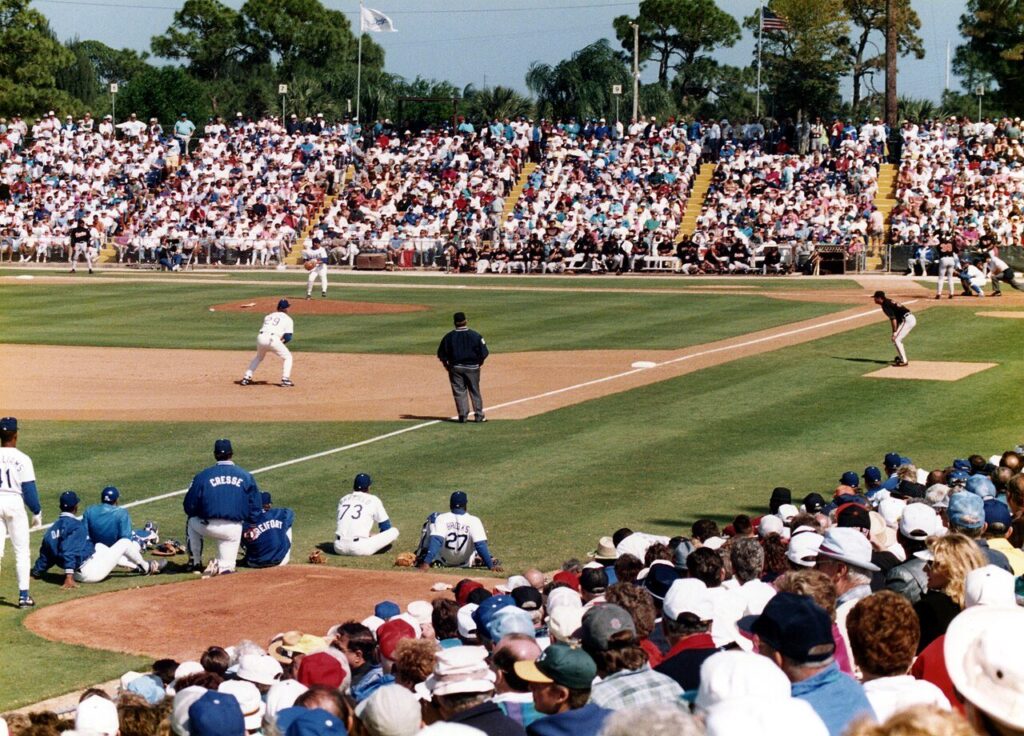
Three names turn up in conversations about baseball in Vero Beach. Dodgertown was a training community, complete with places to eat and sleep. Holman Stadium is the ballpark within it. The Jackie Robinson Training Complex is the name the larger property carries today. Knowing which one a speaker means helps explain an otherwise puzzling sequence. Robinson trained here before there was a Holman Stadium. The stadium kept its identity when the complex took his name. And the history of integration on these grounds looks different depending on whether the person entering the ballpark wore a uniform or held a spectator ticket.
The story starts at an airport. In 1947, Vero Beach businessman and airport director Bud Holman approached the Brooklyn Dodgers about a naval air station that the military had vacated after World War II. Baseball organizations needed space for far more people than the handful of big-league players a spectator might recognize. Practice areas, sleeping quarters and a place to feed a large group could all matter as much as a grandstand. A site designed around a different kind of training offered an unusual answer. The Dodgers began training there in 1948. MLB’s stadium history
A camp with room to teach
A conventional ballpark makes the visitor look toward the nine players on the field. A training camp makes more sense if you imagine following one young infielder away from the main diamond. Where can he repeat a throw, find a coach, eat his next meal and speak with a veteran after practice? Putting people from different levels of an organization on the same property makes those small encounters possible. It also changes the economics of the site. A club may use a stadium for a handful of exhibitions and still need the rest of the property every day for weeks.
That arrangement took on a particular meaning in the segregated South. Black and white members of the Dodgers organization could live, practice and eat together on the property. The U.S. Civil Rights Trail identifies Vero Beach as a milestone in integrated spring training and recalls what seeing prominent Black players meant to young local spectators. Robinson was part of a much larger company. Roy Campanella and Don Newcombe are among the players the trail singles out. Reading the history through several careers helps restore something a single commemorative name can obscure: an integrated team had to function together day after day. U.S. Civil Rights Trail
Training together also exposed the contrast between life inside the complex and the barriers players encountered outside. The ability to eat beside a teammate at camp did not confer equal access to the restaurants, hotels or recreation opportunities of the surrounding area. For a baseball fan, that can change the meaning of the amenities in an old camp photograph. A dining room may be a convenience for an organization trying to keep practice on schedule. For a player facing exclusion elsewhere, the very same room answered a more immediate question about where he would be able to sit down with colleagues.
A grandstand built from the ground
Holman Stadium followed the camp by five years. A long-term lease from the city helped make investment in a permanent ballpark practical. Most baseball maps locate the Dodgers by the city where the team played its regular season. A map of where the players trained would mark a much smaller city on the Florida coast. An agreement over a local property gave the organization reason to put money into a spring home. The Society for American Baseball Research describes the lease negotiations and an initial investment of roughly $50,000 in a stadium with just under 5,000 seats. SABR’s history of spring training in Vero
The builders found part of their construction material on the site. Excavating dirt produced a body of water and supplied earth for the ballpark. An embankment is easy to overlook in a stadium photograph because the eye goes straight to the field. Here it records a decision about what to do with the ground itself. Flat land, a new body of water and a rise around a baseball field belong to a single construction story. On March 1, 1953, the Dodgers opened the stadium against the Philadelphia Athletics. Brooklyn still had its major-league club then. The name Los Angeles belongs to a later part of the Vero years.
Who could sit where
Integration of players' living and training arrangements did not automatically integrate the spectator experience. In 1962, a local biracial committee raised the matter of spectator segregation with Peter O'Malley, then the director of Dodgertown. MLB’s account includes recollections associated with Ralph Lundy, a Black journalist involved in the effort. The importance of that episode is easy to miss if the story jumps directly from Robinson's arrival to a present-day plaque. The question in 1962 concerned how a Black spectator could enter and watch a game, years after Black players had already taken the field for the Dodgers. Complex civil rights history
Keeping the two timelines side by side gives local people a place in this history that does not depend on a major-league roster. A fan, journalist, minister or committee member could influence the conditions under which the public saw baseball. Those roles rarely show up on a scorecard. For a family discussing the site after a game, two questions open up a more substantial conversation than asking who won. What choices could Robinson and his teammates make here that they could not make elsewhere? What choices still had to be won by the person who came to see them play?
The Dodgers held their last Vero Beach spring training in 2008. In 2019, the centennial of Robinson's birth, Major League Baseball announced the new name and an emphasis on developing amateur baseball and softball players. Today MLB describes a working relationship with the local Vero Beach RBI program, including access to fields and meeting space. For young players, that puts the history in an ordinary and demanding setting. They can be on the property because they have a practice to attend, a teammate to find and a game to play. Those are precisely the sorts of ordinary privileges that made the original training community matter. Naming announcement · Youth programs