The baseball prospects who come to Vero Beach to call the game
At Vero Beach’s Jackie Robinson Training Complex, umpire prospects learn the craft behind the calls. Here is how MLB’s camp route differs from attending a game.
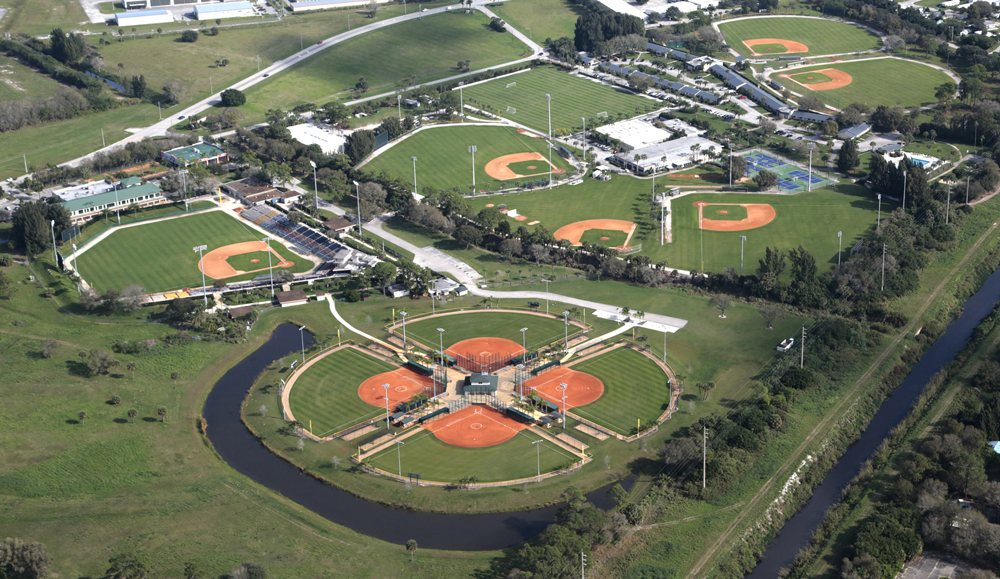
A baseball prospect sent to Vero Beach does not always carry a bat. Some of the people working toward professional jobs at the Jackie Robinson Training Complex have to see where the ball goes, judge what happens and make a call that two teams can understand. Major League Baseball identifies the Vero Beach complex as the site of its Umpire Prospect Development Camp. For a city accustomed to telling baseball history through players, managers and spring training, umpire development adds a different set of questions. How do people learn to see the same play from the right place? And how does someone get a chance to demonstrate that ability?
MLB describes a route beginning at its one-day umpire camps, where supervisory staff observe and teach participants. Selected prospects go through further evaluation and may receive an invitation to the development camp in Vero Beach. The organization describes the latter as a twenty-eight-day program with expenses covered for those selected. A one-day camp and the longer local program are therefore different opportunities. A person interested in applying should start with MLB's current camp information. Driving to the Vero Beach facility on the assumption that the professional development program is open to walk-in participants would miss the selection process entirely. MLB camp pathway · Development camp description
What a good view actually means
Imagine a close play at first base. A spectator down the line might pay attention to the runner's foot. Another spectator looking toward the play from behind the plate might first notice the fielder reaching for the throw. Both are watching the same fraction of a second, but the information available to each is different. An umpire has a task beyond seeing that something happened. They need a position from which the relevant events can be distinguished, then a decision and signal that communicate the result. The training problem begins some time before the runner reaches the bag.
An illustration from ordinary watching is enough to explain why. A view from farther away can sometimes separate two objects that appear to overlap from a closer angle. A coach's view from one dugout may leave an important part of the play hidden behind a player. A spectator with a clear view of a glove may have no clear view of a base. Professional officials are trained for the demands of these decisions. A fan can learn a great deal by noticing where an official moves before a throw and how quickly that position changes when the ball goes somewhere unexpected.
A call also needs to be legible to people who did not see the play. A runner may be facing away from the official. A coach may be across the diamond. The next defensive decision may depend on whether play is still ongoing. A clear signal or voice carries information beyond the narrow fact being judged. On your next trip to a local game, choose one inning to watch the officials immediately after a play. You may see a sequence of movement, communication and readiness for the next pitch that a camera following the ball would rarely capture.
The other profession taught at Dodgertown
The use of the Vero Beach complex to teach officials predates the present MLB camp pathway. A historical study from the Society for American Baseball Research traces umpire schools and describes sessions held at the Vero Beach Athletic Complex, familiar as Dodgertown. It notes the use of the Minor League Baseball Umpire Training Academy name beginning in 2015. An archival photograph from a preceding year can document people training on the grounds even if a caption written later uses terminology associated with a subsequent organization. The continuity is the use of Vero Beach fields for the work. The names and pathways have evolved. SABR history of umpire schools
A training complex suits this work for a reason familiar from other forms of sports instruction. In a live contest, an unusual play may never happen during the game attended by a particular learner. At a training facility, instructors can arrange repeated looks at related situations and discuss what each participant saw. The person being evaluated may learn as much from a different prospect's view as from their own result. Repetition makes it possible to distinguish a lucky first judgment from an ability to observe, interpret and communicate consistently across changing circumstances.
The work also requires a professional relationship with colleagues. A crew can be responsible for a whole field only if each official attends to the right part of it as a play develops. An official may have information another crew member lacks. Spectators who reduce the job to one person announcing a verdict miss that cooperative dimension. A reader of baseball history can ask the same question about the training grounds themselves. How many different occupations have been necessary to stage the games most often remembered through the names of the players?
Following the real entry route
MLB's minor-league umpire information is a better place to start career research than an old school advertisement or photograph of a graduating class. The current organization identifies its national one-day camps, selection and evaluation, the Vero development camp and subsequent opportunities in Minor League Baseball. A position in professional baseball is distinct from a place at an introductory event, and professional work in the minors is itself distinct from assignment at the major-league level. A prospective applicant can use those distinctions to ask sensible questions about dates, travel expectations, selection and what comes after training. Minor-league umpire information
The distinction is useful in conversation with a beginning official too. Ask what they were responsible for observing on a particular play before asking whether they agreed with a call somebody else made. The answer can reveal how officials divided the field and why one person had the decisive view.
For a young local fan, the lasting attraction of the story may be simply learning another way to watch a game. Someone in the seats can follow a player trying to turn a difficult throw into an out and also notice the person moving for a clear look at that throw. Both are practicing a craft, but only one will appear in the batting order. In Vero Beach the fields associated with decades of player development have also given prospective officials a place to learn the part of baseball that begins when a close play needs a call.