The tennis court at Lawnwood where a player can practice alone
At Fort Pierce’s public Lawnwood complex, two hitting walls, a stadium court and twelve lighted courts give beginners, doubles partners and spectators different ways in.
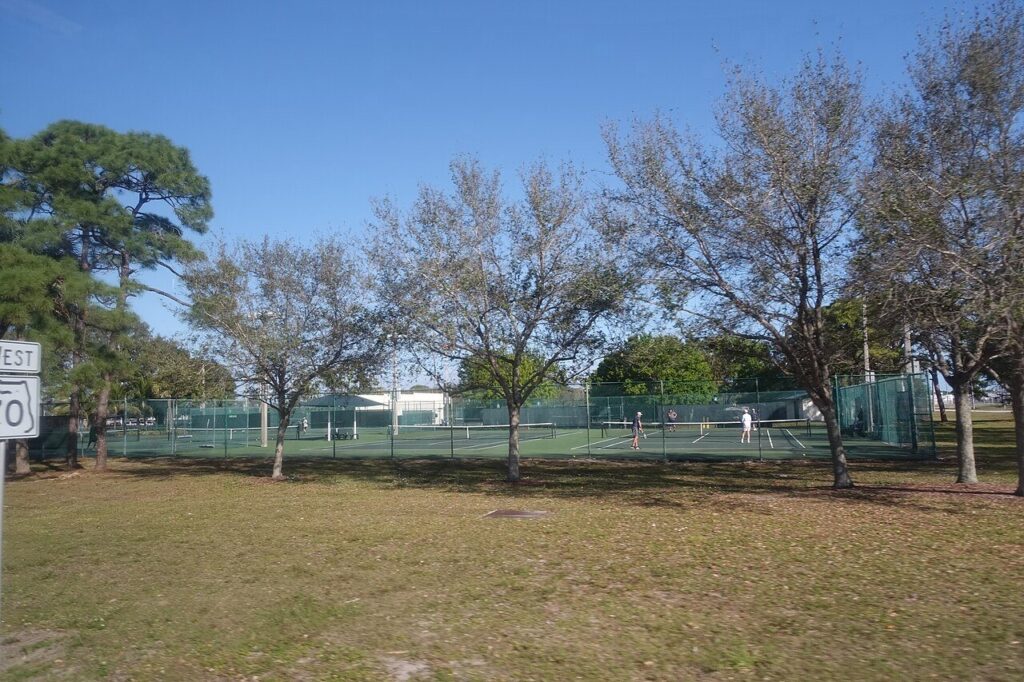
The most dependable tennis partner at Fort Pierce’s Lawnwood Tennis Center never moves, never cancels and returns every playable ball without offering any advice. St. Lucie County lists two hitting walls at the complex. They are a modest detail beside twelve lighted hard courts, two racquetball courts and stadium seating at Court One, but a revealing one. A teenager arriving alone, two adults playing a set and a family member watching a match can all find a reason to come to the same facility. Each will notice quite different things about what the county put there.
Lawnwood is on Virginia Avenue in Fort Pierce. It sits within a larger sports landscape that the county also identifies as the John B. Park Sports Complex, with baseball, softball, soccer, track and field and football among its other activities. USTA Florida lists the tennis venue as a public park. The county expressly welcomes residents and nonresidents. Those descriptions tell a visitor who may use the facility. They do not guarantee a particular court at a particular time, or entry into an instructional program without arranging it with the operator. A player who knows what they want to do can plan the visit accordingly. County tennis center · USTA Florida venue
What a wall returns to the player
In a rally with another person, the outgoing ball becomes somebody else's problem for a moment. A hitting wall makes the connection between cause and effect almost immediate. Change the direction of a shot and the next ball comes from a different angle. Hit harder and there is less time to prepare for the return. It is possible to have a quite absorbing practice without keeping score at all. A simple target such as making several controlled returns in a row gives a player a way to judge consistency while leaving the main courts for games.
The wall also changes what a new player can learn from an experienced friend. In doubles, a beginner may worry that a mistake is ending everyone's point. At the wall a companion can watch one part of a stroke or notice whether the player gets back into position between balls. Nobody on the other side of the net is waiting. A coach can address questions about technique. A friend can simply help count a sequence or take turns. This gives people with different experience levels a way to spend some time at the same place without first having to find a balanced competitive match.
Why a game needs a different space
A tennis court supplies information that a wall cannot. A ball can cross the net and still land out. The part of the opposite court left uncovered changes as another player moves. In doubles, two people on the same side negotiate which one will take a ball down the middle. A player who has become comfortable repeating a shot alone must now choose the shot against a moving opponent. That is why the prospect of a public facility with both walls and playing courts is particularly appealing. A person can return to the same venue as the challenge they want changes.
Lawnwood's Court One gives the spectator a more formal place in the picture. The county describes stadium seating there. A parent or friend can watch beyond the player hitting the ball. Notice where the other player stands before the return or how a doubles partner moves toward the net when a teammate sends a deep shot. The score tells the spectator who won the point. Positioning can reveal why the next shot was possible in the first place. At a facility with many courts, a spectator meeting a player should confirm the court number as well as the street address.
Four of the twelve tennis courts can also accommodate pickleball, according to the county. That line can easily be misread as twelve tennis courts plus four entirely separate places to play. The more accurate picture is twelve courts with some sharing a second use. A group intending to play a particular sport should ask about the available configuration and whether any scheduled activity will occupy the relevant courts. A hard court and a marked rectangle are only part of what makes a game possible. Nets, access arrangements and the group already using the space determine what a player actually finds.
Making a visit fit the people who are coming
The county identifies Flex Tennis for lessons and clinics at Lawnwood and provides separate contacts for the tennis center and instruction. That is helpful for a family deciding between bringing its own equipment for a casual rally and arranging a structured introduction. A lesson inquiry can specify age, previous experience, whether the player has a partner and the kind of game they hope to play. A facility inquiry can focus on current court hours, a group visit, special events or which courts are configured for a particular activity. Each person answering can then address the part they manage. Flex Tennis at Lawnwood
Lighted courts allow play later in the day, and the county posts a cutoff for lighting. The ability to play after work is valuable to people whose daytime hours are fixed, but it makes the ending time as important as the start. A visitor planning a full match should check the day's schedule and leave enough time for the format the group chooses. For someone coming to practice a single skill or play a short rally with a child, a shorter visit can still be worthwhile. The court does not require every recreational outing to finish with a completed set.
For a mixed-ability pair it can help to agree on the afternoon’s aim before opening a can of balls. An uninterrupted rally together, practicing a particular return and playing a competitive set are three worthwhile goals, but two players working toward different ones may leave the same court with very different impressions.
The larger park creates possibilities for a household with mixed interests, as long as everyone knows where to meet. A sibling going to a field and a parent watching at Court One may arrive at the same broad destination without being within sight of one another. The county’s sports complex directory explains the range of activities on the site. Name the facility inside the complex when arranging a ride. And if the prospective tennis partner cannot make it after all, the walls are still there, offering that rare sporting arrangement in which showing up on your own can be enough. County sports complex directory