The living pine at the center of St. Sebastian’s woodpecker story
At St. Sebastian River Preserve, an old living pine helps explain how red-cockaded woodpeckers nest, why open forest matters and how to observe responsibly.
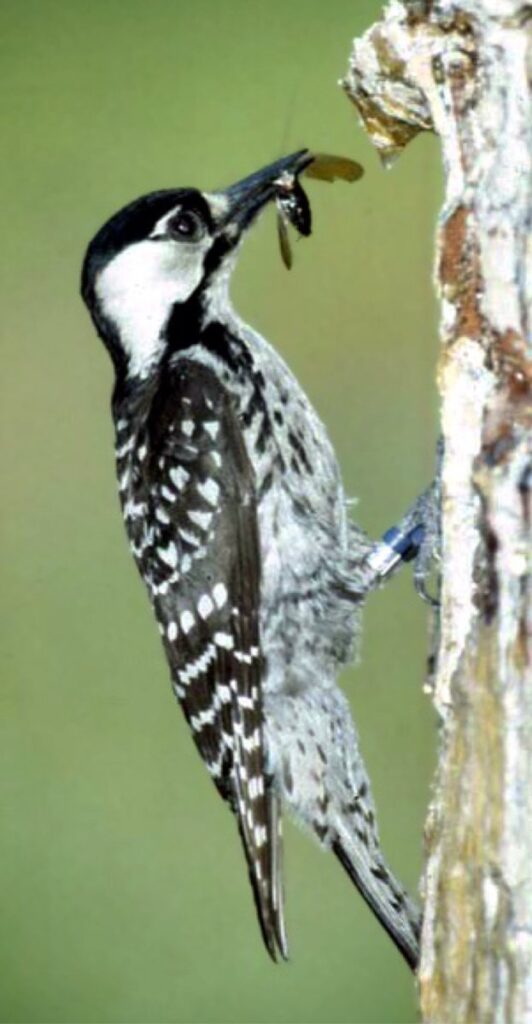
A woodpecker taps a tree. The familiar sound suggests a bird looking for a meal or working into a patch of dead wood. At St. Sebastian River Preserve State Park, one woodpecker makes that ordinary image worth reconsidering. The red-cockaded woodpecker builds its natural cavity in a living pine. Picture the problem from the bird’s side. It needs a trunk large enough to contain a usable space, wood that it can gradually excavate and a forest in which the tree can remain standing through years of work.
Start with the tree
The U.S. Fish and Wildlife Service species account describes a preference for mature southern pines, particularly longleaf. In some older trees a fungus softens the heartwood deep inside. There is still living wood on the outside. Getting through it is a substantial investment. The service gives a range of one to six years for cavity excavation. A tree planted today cannot immediately replace one that already has both the necessary interior and a finished cavity.
That time lag changes how one reads a forest. Counting trunks in a photograph tells you that a place has trees. It tells you little about how many trunks are mature enough for these birds, how many cavities are usable and how those trees are arranged in relation to the birds’ feeding area. A stand can look green and vigorously alive while lacking an important part of what the woodpecker needs. A single older trunk left in isolation also cannot supply the full range of resources a group uses.
There is a visible clue to the bird’s unusual relationship with living wood. The federal account describes small resin wells on active cavity trees, where sap runs on the trunk. Think of a living pine as a changing surface rather than a static wooden wall. Look at a diagram or an agency photograph before going to the park. It gives you features to understand without having to locate or approach an occupied cavity yourself. A trickle of sap alone is insufficient to identify a nesting tree.
The bird’s name is a poor first clue
The Florida wildlife commission’s identification guide points out a feature beginners often miss in field guides. The small red mark found on males is rarely visible. Waiting for an obvious red patch is therefore a poor way to identify this bird. Learn the white cheek, the dark head and the barred black-and-white back. Then look at the whole bird, where it is feeding and how much detail you were actually able to see.
On an outing, try describing a woodpecker before looking at its name in a reference. Which part of the face was pale? Was the back barred, solid or partly obscured by the trunk? Did you observe the same individual through binoculars and in the photograph? A small bird can move around a pine and another can come into view from behind it. If you saw only a flashing wing or heard a tapping sound, leave the identification open. Recognizing the limit of an observation is part of becoming a better local birder.
The federal service also describes the group’s use of a cluster of cavity trees and feeding territory. That helps explain why visitors may be looking at the right kind of forest without seeing a bird in a particular pine. Feeding, resting and occupying a cavity are different activities, and group members can move through a larger area than is visible from a trail. A still image cannot represent that whole pattern. Resist the urge to move closer to a potential cavity to force an encounter.
Read the preserve’s notices as closely as its bird list
The state park’s public page describes its longleaf pine landscape and provides current access alerts. As checked in late November 2026, the park’s notices describe flooding and limited access. A visitor-center parking lot or an open segment at one entrance does not imply an open route across the property. Consult the current notice and contact the park if your planned trail is ambiguous. A visit to another site or a later date is preferable to setting off along a closed route to look for a particular species.
The park also maintains an interpretive article about its woodpeckers. Its older headline uses the word “endangered.” For the current federal designation consult the federal reclassification published in 2024 and the state species profile. The bird is federally threatened. This is a useful example of two sources that answer different questions: a park feature introduces a species found there, while a dated federal decision establishes a change in its listing. An older headline can outlast the designation it described.
A good visit without a sighting
Make one goal independent of whether the bird appears. From an open, designated route, compare trunks in the foreground with those farther off. Pay attention to spacing, height and the amount of daylight reaching the ground. A simple sketch of the stand can be more revealing than a picture pointed straight up at the canopy. It shows how an animal could travel from one feeding tree to another and why an opening in a pine forest does not automatically mean the place is missing something.
If you visit with someone new to birding, give them the binoculars while you use a guide to describe the habitat. Compare notes afterward. The observer may have seen a shape that the person reading did not, while the reader may have noticed an important difference between a likely identification and an actual one. The best account you bring home may be that you found a living example of the kind of landscape described in the agency references, with no confident sighting that day.
A useful comparison after a visit is between a photograph of a bird and one of its surroundings. Crop the tree away from the first image and most of the identification features remain. Crop the trees away from the second and almost all the information about long-term nesting suitability disappears. Learning to keep both kinds of picture is a practical contribution a visitor can make to a conversation often dominated by a single bird portrait.
For residents on the coastal side of the county, the preserve provides an especially good reason to learn about western habitats. A forest that can appear repetitive through a car window contains trees of different ages with very different potential value. Understanding the years invested in one cavity gives the whole stand a history. The next time a woodpecker drums somewhere nearby, the interesting question might be about the tree it has chosen as much as the bird making the sound.