How a dune-top dining room became Vero Beach’s Ocean Grill
Trace the Ocean Grill from a 1941 dune-top restaurant through its wartime use, family stewardship and the storms that altered its dining room.
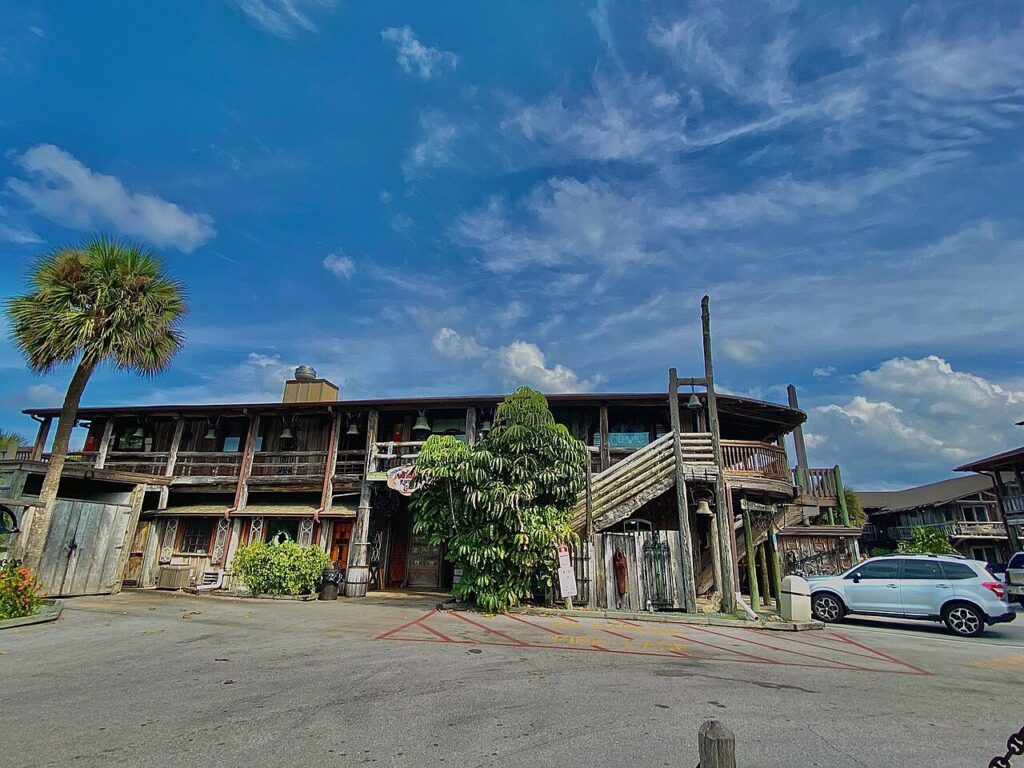
The most revealing detail in the Ocean Grill’s story might be the floor. A customer who comes to the Vero Beach restaurant for an Atlantic view is entering a room whose original terrazzo floor disappeared during the building’s long encounter with the coast. The roof survived. The floor below it had to change. That seems like a small architectural footnote until you put it alongside the restaurant’s beginnings on a dune, its interruption by war and the decades of people who chose to keep serving food there.
Ocean Grill publishes an unusually personal account of the building. Its stories come from the establishment itself. They are best read alongside the Waldo Sexton chronology published by the nearby Driftwood Resort. The chronology makes it possible to separate three subjects that local shorthand tends to combine. There is the land at today’s Sexton Plaza, the restaurant building that opened in 1941, and the succession of people who used it. They do not all have the same starting date.
A place to eat before the famous building
The Driftwood timeline traces Sexton’s beach property back to 1915 and records an earlier hot dog stand in the late 1930s. That detail is easy to miss in a history dominated by the later dining room. A stand and a sit-down restaurant answer different needs. A stand can feed people who are already at the beach. A restaurant with a distinctive building and furnishings can give people a reason to make an outing to the beach in the first place. Both were part of the story of this piece of shoreline.
According to the Grill, the builder drew on stores of materials that included pecky cypress, mahogany and ironwork. The point was not to assemble a matched dining suite in one recognizable style. Different materials brought different weights, textures and histories into the same room. A useful way to look at an eclectic building is to choose one category at a time. Look at how a piece of iron meets the wood that supports it, then consider whether it seems to belong to the same design language as the next piece.
The roof came after the first diners
The restaurant dates its first meal to New Year’s Eve and says the principal dining space initially operated as an open patio. In the Grill’s account, sandflies made that experiment brief. A roof followed. A reader accustomed to thinking of an oceanfront restaurant as a finished piece of architecture can reverse that picture. The first customers effectively helped expose a design problem. Open sky could be part of the attraction and still be an impractical way to serve dinner night after night.
That first adaptation had a very different cause from the losses of later decades. One was about the practical discomforts of sitting outside. Another was about the forces acting on a building at the edge of the water. It is tempting to put every change down to a colorful owner’s whim. The floor and the roof tell a more interesting story about the number of parties involved in shaping a restaurant, including some very small insects and an ocean that pays no attention to a floor plan.
Dinner interrupted by a naval air station
The chronology calls the early operation Gus and Emma’s Ocean Grill. It records its closure in 1942 and the building’s use the following year as Club Mac, an officers’ club serving the naval air station. The change in use is more precise than saying vaguely that the restaurant “survived the war.” A building can remain in place while its customers, purpose and management change substantially. Here a room created as a civilian seaside destination became part of the social geography of a military town.
Postwar names and operators followed. The family now closely associated with the business enters the published timelines much later. The Replogles arrived from Milwaukee in 1965 to lease and operate the Grill. In other words, crediting Sexton for the building and the Replogles for long operation describes two different achievements. Keeping a business going through changes in service, weather and clientele takes a kind of stewardship that a single opening date cannot capture. The founding story explains why a landmark exists. It does less to explain why there is still dinner inside.
What storms did to the restaurant
The Grill recounts storms in 1974 and 1984 and says the original floor was lost, while wooden pilings and a plank floor took its place. It also records hurricanes Frances and Jeanne in 2004. These are historical accounts of specific episodes, rather than an assessment of present structural condition. They explain why the restaurant points visitors toward its floor as well as toward its view. What diners see today includes decisions made after the original builder and original customers were gone.
The restaurant also mentions an underwater reef installed offshore in 1996 and offers its own tentative interpretation of subsequent changes in the beach. The existence of a project and its effect on every later change in the sand are different claims. For a visitor, a more productive observation is that today’s distance between a dining room and the water cannot simply be projected backward onto the site in 1941. Buildings and shorelines keep different calendars. Old pictures and dated accounts can make their changing relationship much easier to see.
Follow the builder to a second address
The Historic Driftwood Resort describes its original inn and restaurant buildings as Sexton’s work from 1935. Today Waldo’s Restaurant identifies its home within that resort at 3150 Ocean Drive. These are related landmarks with distinct histories. If you visit both, compare the uses of wood, decoration and enclosed space rather than trying to identify a single signature feature that proves a building “looks like Waldo.” The businesses themselves provide a useful starting point for that exercise.
For someone taking a relative to lunch, the story can be told with just three stops in time. Begin with a dune and an open-air meal. Pause when uniforms replaced the first civilian clientele. Finish with a family that took over a generation after the building went up and kept working through changes to the very surface under the tables. That leaves plenty to talk about before the food arrives. It also gives the view out the window some depth beyond whatever the Atlantic is doing that afternoon.