Pompano or permit? Find the answer in the fins
A fish identification guide for Vero Beach surf anglers, with the fin positions, body proportions and photographs that separate Florida pompano from permit.
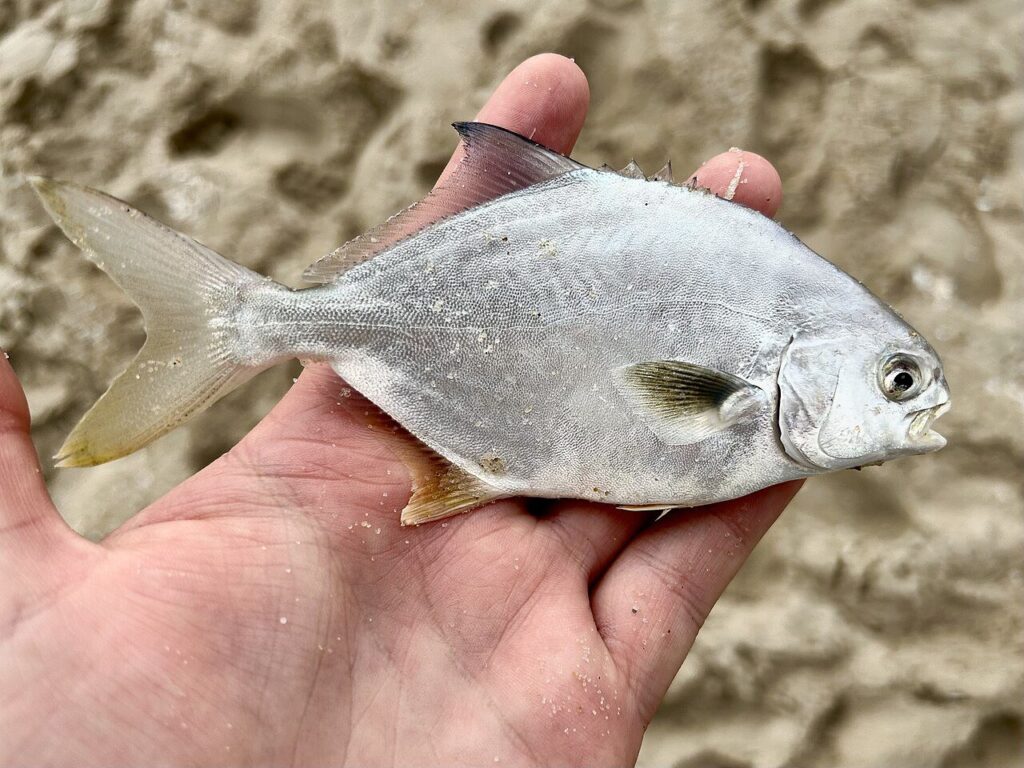
A small silver fish comes out of the surf broadside, flashes yellow underneath and disappears into an angler’s hands. Someone calls it a pompano. Someone else calls it a baby permit. Both have noticed something real. These members of the jack family can overlap in size, and either one can look like an expensive piece of silverware in the brief interval before a camera adjusts to Florida sunlight. The quickest way to settle the argument is to stop looking at the shine. Follow the outline of the fish and find where two fins begin.
For an angler at Vero Beach, there is a good reason to practice this on land. A fish identification made from memory a day later has to survive a surprisingly slippery series of questions. Was the dark patch a marking or the shadow of someone’s hand? Was the tall fin on the back or behind the gills? Did the fish itself look long, or was the person holding it stretching an arm toward the camera? The state’s side-by-side identification guide gives those questions a sensible order. Start with the features whose positions are least likely to change.
Where the fins meet the body
Find the long dorsal fin along the top of the fish and the anal fin along the lower edge behind the belly. The important point is the front of the attached part of each fin. A fin can sweep backward when a fish swims, gets wet or lies against a net. Its origin stays attached to the same place. Imagine a vertical line passing through the start of the lower fin, straight across the fish to its back.
On a Florida pompano, the upper fin begins farther forward, toward the head. On a permit the two origins appear one above the other. In the water the distinction can pass so quickly that the exercise sounds fanciful. On a clear photograph with the fish held level, it becomes quite a practical test. Hold a scrap of paper against the screen and line its edge up with the lower origin. It takes seconds and requires no app to guess what the picture shows.
The distinction falls apart if the lower fin is hidden. One common photograph shows a smiling angler above a fish held against a shirt, one hand cupping the belly right over the landmark. Another shows a fish tilted nose-first toward the lens. Both make fine souvenirs. Neither gives a second viewer the measurement that matters. Leave the identification open if that is all the evidence the photograph contains.
The silhouette offers a second opinion
Florida’s pompano profile describes relatively short, upright dorsal, anal and tail fins. The tail fork is broader than a permit’s. A permit carries longer fins that sweep back and a more narrowly forked tail. You can see why a quick drawing can teach more than three photographs taken from bad angles. Sketch the top and bottom outlines on a grocery receipt. Make the fins small and upright in one drawing and sloped back in the other. Then add the fin origins. You have two quite different outlines without having to color in either animal.
Use overall shape as supporting evidence. A fish turned slightly toward you looks shorter and deeper than when it is square to the camera. A tail spread wide in the water can fold when lifted. A torn or folded fin may turn the outline of an otherwise typical animal into a puzzle. A second matching feature gives the first observation weight. A disagreement between features gives an angler a reason to go back to the picture, enlarge the outline or set the identification aside.
Color is enjoyable to observe and difficult to keep consistent. Florida pompano can show yellow on their lower surfaces, and FWC specifically notes coloration associated with dark water. A photograph taken beneath a yellow beach umbrella can make the belly of almost anything look golden. Try looking at the same image in grayscale. If the only thing that supported the initial identification disappears with the color, it was quite a thin case.
What size can tell you
A large adult permit can reach dimensions well beyond a Florida pompano. The state’s permit account makes that difference plain. It does much less to distinguish two small fish. A juvenile of the larger species has to pass through many of the same sizes as the smaller one. An angler who rules out permit because a fish fits in a small net has made an assumption about age without first establishing species.
There is another difference involving teeth on the tongue of a small permit. It belongs on the page for anyone studying a scientific description. On a beach, a camera-side view of the fins is an easier place to start, and it avoids opening a live fish’s mouth to satisfy a curiosity. If you already intend to release the fish, there is no need to keep it out of water while people gather round to vote. Take the available picture and let the discussion continue ashore.
A side view also makes a better field record. Record roughly where you were, whether the fish came from the open beach or near an inlet, and which marks you could actually see. The place adds context. It does not confer an identity. Even a very specific statement such as a fish came from the surf on an outgoing tide leaves both the outline and the fin positions unanswered. Resist the temptation to let a familiar fishing spot name the animal for you.
Make the second picture count
If a companion already has the camera ready and the fish can remain supported and wet, ask for one straightforward side view. Keep both the nose and the entire fork of the tail in frame. Turn the camera to follow the fish instead of bending the fish to follow the camera. A simple picture that shows where both fins attach is more informative than a dramatic close-up of the eye. When the animal has already gone, keep the imperfect picture and label it accordingly.
Identification is one job. Deciding whether any fish may go home is another, with separate state species pages for each fish and regulations that depend on the applicable place and date. A surf angler who cannot resolve the first question has a perfectly good option in releasing the fish. The better souvenir is the next encounter. The first time you spot the little offset between the fins without reaching for your phone, two almost identical flashes of silver finally become two recognizably different fish.