From a stingray pool to a mangrove trail on Hutchinson Island
Plan a visit to Stuart’s Florida Oceanographic Coastal Center, from the stingray and sea turtle programs to the mangrove loop and its link to seagrass research.
One of the most revealing things you can do at the Florida Oceanographic Coastal Center is turn your back on the sharks for a few minutes. At an exhibit called Water Journey you can work a lock or dam, change a current and watch water go somewhere it did not go before. Later, on the trail to the Indian River Lagoon, the same question takes on a different scale. Where did this water come from, and what can live in it by the time it reaches the coast?
The Hutchinson Island center outside downtown Stuart gives visitors several ways to answer. The Ocean EcoCenter has aquariums and freshwater-to-estuary lessons. A large outdoor lagoon puts native fish in front of the people who feed and care for them. A walk through mangroves leads to the actual Indian River Lagoon. The institution also grows and studies seagrass for restoration elsewhere along Florida’s east coast. Getting among those four parts of the site makes a considerably richer visit than trying to catch every animal presentation on the same afternoon.
Pick the encounter you would most regret missing
Use the Coastal Center’s program descriptions to set one appointment for the day. The stingray education program and the opportunity to touch a ray run separately. Visitors who come for the talk can learn about rays and their shark relatives, but interaction takes place in different windows. A family aiming for both should check the current schedule before setting off. A visitor who wants only to watch can plan for the talk and leave the interaction period free for something else. Follow the animal care team’s instructions at the exhibit.
The Gamefish Lagoon holds about 750,000 gallons. During its program the animal care staff feeds residents while visitors learn about fish that live in nearby waters. That is an unusually good occasion to ask how staff tell one individual or species from another. A clear observational question works especially well with children. Choose one fish and see how it positions itself as others move, then ask a staff member about the behavior. An answer attached to an animal in front of you tends to last longer than a list of names collected at several tanks.
The sea turtle program brings the visit back to the beach outside. The center distinguishes the five sea turtle species found in Florida from the three that nest along Martin County’s beaches. That distinction is an excellent question for the educators. Which clues help somebody identify a turtle in the water, and what different evidence suggests nesting on land? Seeing a resident animal and learning to recognize a species are achievable goals here. A sighting on a particular stretch of public beach on the way back to the hotel is a matter of chance.
Follow the water inland and out again
The center’s visitor guide describes Water Journey as a chance to direct water through wetlands, estuaries and rivers. Two people can turn this into an experiment. Have one make a change while the other watches downstream and predicts where the water will go. Switch roles and put things back the way they began. Children who would never read a long display about water management can come away with a genuinely difficult question. If you can move water away from one place, what happens in the place that receives it?
For an outdoor visit, the nature trail makes a one-mile loop to the Indian River Lagoon and back through a mangrove swamp. The society also lists a guided introduction that meets at its seagrass nursery on designated days. Check the posted program for the date you intend to visit. A short guided introduction and the full walk are different commitments. Someone with limited time can ask where the introduction ends before setting out, while those planning the entire loop can leave room afterward for whichever animal program matters most.
The center encourages people to contribute photographs to iNaturalist. This can change how a group walks. Pick one reasonably stationary subject, such as a mangrove leaf, and take a picture that actually shows what you want identified. Include a second view if the first leaves out the shape of the tree. There is no benefit in accumulating a dozen blurry sightings that nobody can interpret later. If the group splits, arrange to meet at a named exhibit. A person trying to frame a butterfly will move through the trail at a different speed from someone heading directly to the lagoon.
A grass nursery with a job beyond the aquarium
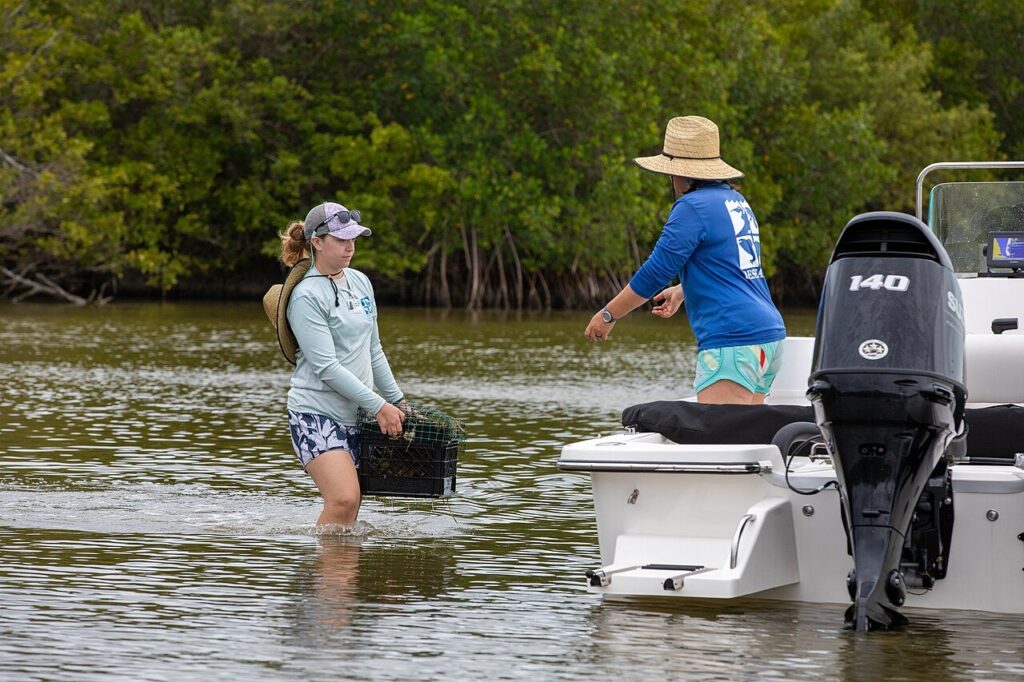
Seagrass connects this island attraction to work far beyond Stuart. Through its FOSTER program, Florida Oceanographic trains people to help monitor and restore underwater grasses in the Indian River Lagoon. The plants shelter juvenile animals and hold sediment in place. The society monitors established and restored beds, allowing researchers to ask whether planted areas survive and grow. A nursery can therefore be more than a stockpile of plants ready to move. What survives once the plants enter open water is one of the most important results of all.
In March 2023, NASA documented society workers preparing seagrass mats at Kennedy Space Center for a pilot planting in the Banana River. The space center’s account of the project describes a plan to distribute at least 28,000 shoots across 18 sites. Those numbers were a planting target, distinct from any subsequent count of surviving shoots. The photograph accompanying this story comes from that work at Kennedy. It helps explain why the society’s Stuart visitor site includes a nursery alongside the more familiar aquarium exhibits.
On the way out, ask everyone to choose one thing they would recognize again at the coast. One person may remember a stingray’s outline, another the architecture of a mangrove, another a mat of seagrass poised to be planted. Return to the water exhibit if time permits. The small change made by a child opening a model gate now leads to real questions about fish, turtles and submerged plants. That is a souvenir you can take straight to the next bridge or beach on the Treasure Coast.
For a return visit, reverse the route. Begin with the mangrove loop and write down one question about the water there. Bring it to the animal care presentation, the turtle program or the seagrass nursery. This time the living shoreline supplies the question and the exhibits supply several possible answers.