Three photographs hiding in one waterlily pond at McKee
McKee Botanical Garden’s waterlily collection and past photo exhibitions offer three ways to look at a pond, from color portraits to black-and-white compositions.
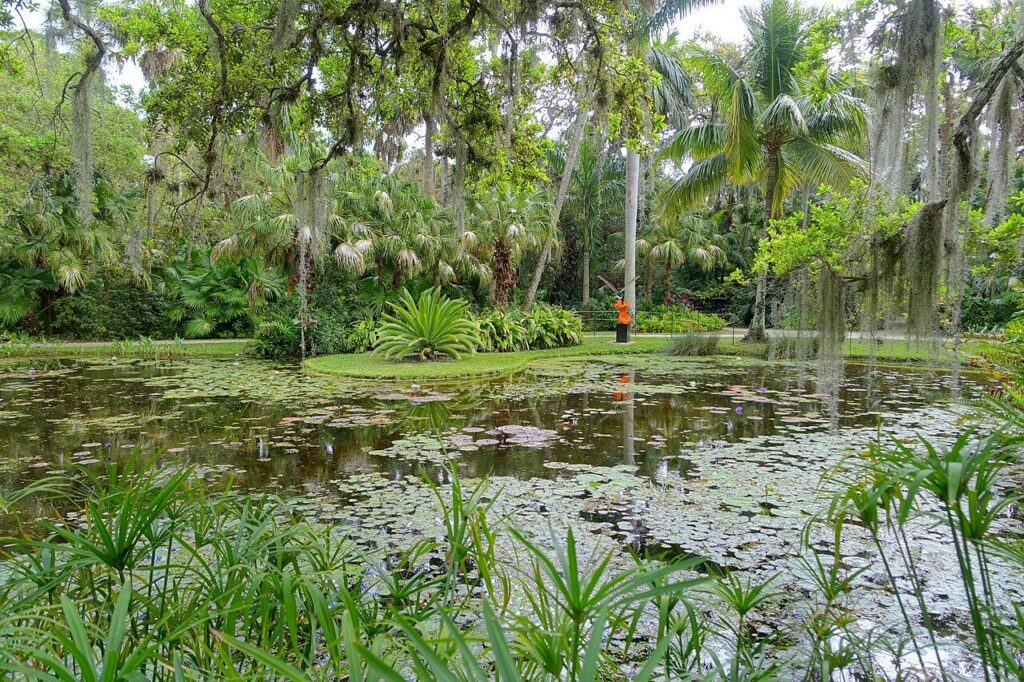
A photographer can point a camera at a waterlily and come home with a picture of the sky. The same patch of pond might hold a flower, the edge of a bright pad, a reflection of something behind the photographer and a dark gap through which the water itself almost disappears. Deciding which of these belongs in the picture is the first creative act. At McKee Botanical Garden in Vero Beach, an annual celebration and a long-running photographic tradition have made that small decision part of the local arts calendar. You do not need to enter a contest to appreciate the problem its photographers face.
McKee's account of its June 2026 Waterlily Celebration describes waterways planted with a collection that has continued to grow since the first celebration. More than forty photographs were entered in 2026. The garden displayed them in its historic Hall of Giants, around the long table known as The Board. A flower, a leaf surface, a group of plants and the larger planted waterway can all tell true but different stories about that place. Start by deciding which part of the garden deserves a frame. McKee’s account of the 2026 display
The color photograph
The rules for McKee's 2024 photo exhibition make an excellent exercise even years beyond the entry deadline. One category was color. When the subject is a colorful flower the obvious choice is to let it fill the frame. Before doing that, look at what happens where its petals meet their surroundings. A pale petal against dark water describes an edge quite differently from the same petal overlapping a light green pad. A change in where you stand on the public path can alter the background while the flower itself remains quite still. McKee’s 2024 contest announcement
A second color picture might include the surroundings. There is often a temptation to eliminate every leaf with a blemish or every awkward corner of a reflection. But a botanical portrait and a picture of a living pond can have different ambitions. A leaf beginning to deteriorate records a different moment in the life of the planting. A patch of reflected foliage can link the flower to the garden around it. If you keep either detail, arrange the frame so that the viewer can understand the choice. Something pushed against an edge by accident reads differently from something given space to be seen.
For a visitor working with a phone, comparing two frames can be more instructive than trying to find the perfect camera setting. Make one image in which the flower is central and another in which the relationship between plant and water has the larger role. Look at them later without their titles. If a friend can tell which is meant as a portrait and which as a view of a place, the composition is doing some of the explaining. The name of a variety, if known from garden information, can then add botanical precision to what the image already shows.
The black-and-white photograph
Another historical contest category was black and white. This changes the task quite radically. Two parts of a flower that differ dramatically in color may have similar brightness and merge in a monochrome image. A dark line at the edge of a pad or a white reflection breaking up a pool of darker water may become the strongest elements in the frame. A viewer who came to photograph petals can end up photographing intervals, arcs and repeated shapes instead. The pond offers the same material, but the visual hierarchy has changed.
One exercise is to look at a small group of pads and draw its outline in the air with a finger before making a photograph. Where does one shape disappear beneath the next? Where does a gap of water interrupt the repetition? A photograph can make the viewer curious about that gap or can hide it entirely. Try comparing a view across the pond with a steeper view from a permitted spot along the path. The apparently round shape of a pad can narrow into an oval as the angle changes, creating a pattern quite different from the one visible on first approaching the water.
The 2024 results make a good case for giving monochrome a try. Landscape photographer Ngoc Minh Ngo chose Tina Baxter’s black-and-white image Lotus Love as best in show. The pictured lotus took that award in a competition with waterlily in its name, a reminder to read the actual subject as well as the exhibition title. The garden had specifically invited pictures of both waterlilies and lotus. Look at Baxter’s winning photograph beside Les Greenwood’s first-place color entry, My Happy Place. Hues carry some of the visual weight in Greenwood’s image. Baxter’s picture invites a much closer look at the shape of individual petals and the structure of the flower’s center. McKee’s winners and photographs on WQCS
The deliberately changed photograph
McKee also recognized manipulated images in 2024. Baxter won that category with a separate entry called Floral Love. When making your own manipulated picture, try keeping an unaltered version alongside it. The pair makes choices visible that are otherwise difficult to describe. What was in the camera frame? What changed after the exposure? A person looking at a finished print may appreciate an abstract pattern without being able to reconstruct how it was made. Keeping the original allows the photographer to explain the transformation precisely. It also distinguishes artistic interpretation from a claim that a plant actually appeared in precisely that form or color.
The visitors’ favorite in 2024 was another photograph entirely. John Sinclair of Vero Beach received the People’s Choice award for Egyptian Bloom. An audience and a judging panel can agree that a collection is worth looking at while finding very different reasons to pause in front of an individual picture. Presentation can shape that encounter too. Two pictures displayed at the same scale and without a name across the front invite attention to the work itself. A family can borrow that idea quite easily. Place three equal-sized images together: one color, one black and white and one deliberately transformed. Ask which of the three tells you most about the plant, and which tells you most about the person who made it.
That small exhibition can begin with a single Vero Beach pond. A change in light or a ripple will alter what appears in the water, and the plant will continue growing after the camera leaves. The collection gives the photographer a subject; the act of making a picture gives a visitor a reason to spend more time noticing it. That is a substantial return on a morning in a garden, even if the photographs never leave a phone.