Five gables and a million-dollar idea at Fellsmere’s Heiser House
Frank and Stella Heiser’s Florida bungalow links a sales office, a 20-acre farm, a railroad and a sugar mill that changed the working life of Fellsmere.
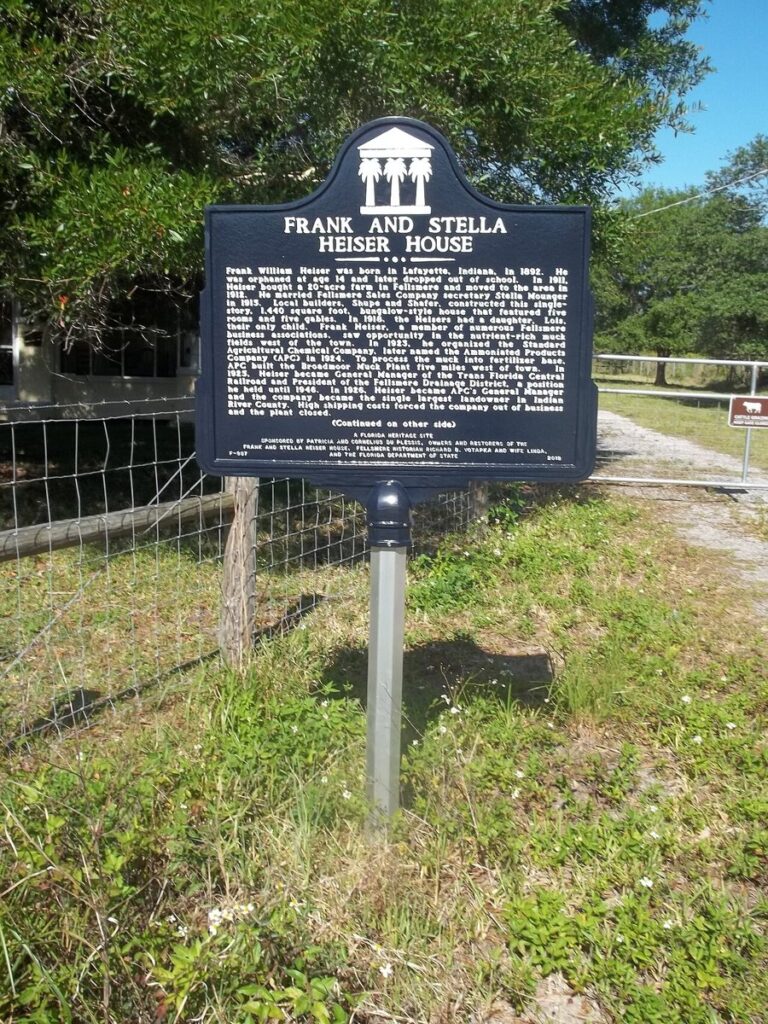
The building associated with one of Fellsmere's most ambitious industrial ventures is a bungalow with five rooms and five gables. A sugar refinery, a railroad line and a company sales office make better sense of it than an inventory of domestic furnishings ever could. Frank and Stella Heiser came to Fellsmere by different routes. He purchased twenty acres. She came with the sales office that helped bring people to the developing town. Their house provides an unusually personal starting point for a much larger story about how land, capital, transportation and paperwork were assembled in inland Indian River County.
The state historical marker says Frank Heiser bought his farm in 1911 and arrived in 1912. Stella Mounger moved to Fellsmere in January 1913 when the sales office relocated from Chattanooga, according to the National Register nomination. The couple married in 1915 and their daughter, Lois, was born in 1918. Local builders Shupe and Shafer constructed the roughly 1,440-square-foot house. The dates of individual arrivals matter here. The story begins with two working people involved in the formation of a community, each with a reason of their own for coming to Florida. Florida historical marker · National Register account and photographs
A secretary enters the town's history
The phrase “sales office” can pass unnoticed in an account of land development, as if the fields simply attracted their future owners by themselves. An office moving from Tennessee to Florida indicates a more substantial operation. Buyers had to be reached, inquiries answered and transactions documented. Stella worked as a secretary for the Fellsmere Sales Company before her marriage. The nomination documents her later work as Frank's secretary during his involvement with the sugar industry, as well as her connections to the school and church. A record that names only the entrepreneur would miss a considerable amount of the labor that helped an enterprise function.
The surviving bungalow is a corrective to another common assumption. Buildings connected with sizeable business ventures need not be grand houses. A front porch and a family-sized arrangement of rooms preserve a different scale of life from a mill. The nomination includes an exterior photograph from around 1925 and later views that allow readers to compare the form over time. Trace the line of the roof in the older image before concentrating on details that are easier to see in later photographs. Vegetation, paint and porch treatment can alter a first impression without erasing the underlying shape.
There is no need to assume the interior is open to visitors to study the house. The registration file supplies photographs, descriptions and an account of how the surveyors evaluated the property. The historical marker gives a much shorter life history for a reader in the field. Each format does a different job. The marker cannot show the grain and arrangement of porch flooring or the relation between a door and a set of gables. The registration file cannot reproduce the experience of seeing a domestic building in the community where its owners made their living. Together the two records improve the account.
Why rail and drainage appear in a sugar story
In 1925 Frank Heiser became general manager of the Trans Florida Central Railroad and president of the Fellsmere Drainage District. The state marker records his involvement in an agricultural chemical enterprise whose economics were undermined by shipping costs. That is a telling episode in a place planned around agricultural opportunity. The ability to produce something from land is only part of the calculation. A business must also move its product to someone prepared to buy it. A tract that looks promising on a land map can be a very different proposition once transport enters the balance sheet.
Drainage and transportation also create different kinds of dependency. A single farm owner may be able to decide what to plant. They usually cannot make a regional system for managing water or a connection to distant buyers appear on their own. The people organizing Fellsmere had to work across property boundaries and recruit investment from beyond the town. The local historic walking tour traces a succession of companies and identifies Heiser in efforts to establish the chemical business. Those changing names are a reminder that surviving structures may outlast the corporate arrangements under which their owners first began work. Historic walking tour’s Fellsmere history
The test crop and the mill
The state records a first test planting of sugar cane in 1927 and a move to one hundred acres in 1929. A promising field and a working mill were still two different achievements. Heiser traveled between Fellsmere and New York in 1930 and 1931 to secure financing. The historical marker puts the amount raised at a million dollars. The new sugar company was established in 1931, with the mill built the following year using material from the former muck plant and a Louisiana mill. The company did not begin with an entirely new set of buildings and machinery. The earlier ventures left physical assets as well as experience.
By 1933, the state marker says, the mill had produced two million pounds of raw sugar and employed 225 people. Later came a cooperative structure and a refinery. Keep “raw” and “refined” beside the figures when comparing accounts. They describe different stages in production. A capacity figure for how much a refinery could produce in a day is different again from a total actually made over a season. Read precisely, the numbers illuminate an important regional industry. Read loosely, they can make entirely different claims sound like competing estimates of the same thing.
Another number worth pausing over is the payroll head count. Hundreds of jobs imply hundreds of household journeys to and from work, skills passed between shifts and purchases made in the surrounding community. Those experiences extend well beyond the names preserved in a company history and are promising subjects for local oral histories.
The Heisers eventually left Fellsmere, and the sugar enterprise changed hands. That makes the family house especially valuable as a point of return. A reader can follow the family's movements through a sales office, a farm, railroad management, business travel and a refinery and still finish at a modest home with a traceable builder and a documented front porch. The state marker has two sides because a full public career takes some telling. The house adds a dimension the marker alone could scarcely hold: this regional story also belonged to people who came home at the end of the day.