A scrub-jay’s family puts Wabasso’s sandy trail in perspective
On the Wabasso and North Sebastian scrub trails, learn why low oaks, sandy openings and family territories matter to Florida’s native scrub-jay.
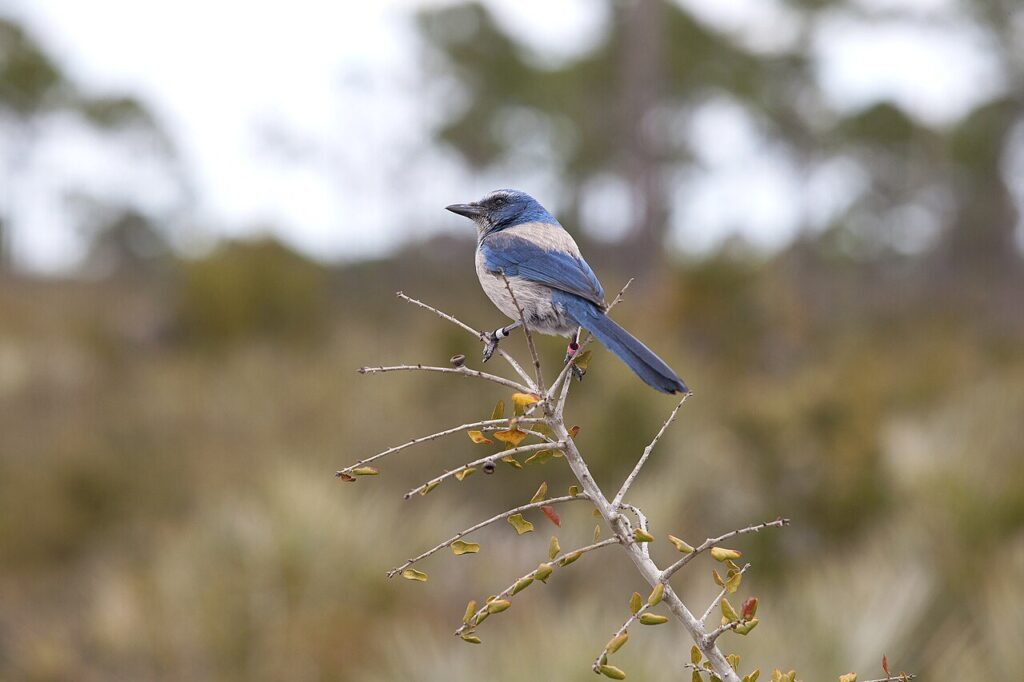
If a Florida scrub-jay flies from one side of the trail to the other, the whole encounter can last less time than it takes to adjust a pair of binoculars. What remains in view for the rest of the walk is its home. At Wabasso Scrub Conservation Area, that is a revealing place to start. Much of the vegetation sits low enough for a walker to see patches of sky and stretches of sand instead of the continuous canopy people often picture when they hear the word conservation. For a bird adapted to oak scrub, that open structure is one of the main reasons to be here.
The starting point deserves a clear description because the name of the preserve and the name of the parking area differ. The Great Florida Birding and Wildlife Trail’s Wabasso guide directs visitors to park at West Wabasso Park and find the entrance kiosk at the park’s southeast corner. From there the guide describes a one-mile trail heading east and then south. Sand pine scrub, oak scrub, flatwoods and seasonal wet places appear along its route. A single morning here can contain a much broader walk than the name of the conservation area suggests.
The family behind a single blue bird
A Florida scrub-jay is a bird of Florida, with a natural range confined to this state. An individual sighting therefore belongs to a remarkably local story even before an observer can say anything about this particular bird. Unlike a visitor passing through on migration, scrub-jays maintain territories and live in family groups. The state’s species profile describes a breeding pair with helpers, often their own offspring from earlier years. Helpers can assist with raising young and defending the territory.
That changes how to interpret a second bird coming up behind the first. The two might be related, but a casual observer cannot assign parentage or determine that the second animal is a helper simply by watching it land on a branch. A careful record would describe the number of birds, where they appeared relative to one another and any actual interaction. The biology supplies a plausible explanation for finding several nearby. It does not supply names, ages or family roles for every blue individual that enters the frame.
It also explains why photographs taken at a familiar corner can give a misleading impression of local abundance. Three visitors photographing one conspicuous group on the same morning do not establish that three different families use the site. Reliable population estimates require observers to distinguish birds or territories in a consistent way. A resident taking a walk can still make a valuable observation. A note that says two birds together at a particular time is more useful than an enthusiastic claim that the entire preserve was full of them.
Learn what the oak is doing in the picture
The diet listed by FWC includes acorns and insects as well as some small animals. A low oak in a scrub-jay photograph is more than an attractive perch. It helps furnish food, cover and the arrangement of open ground and vegetation that defines scrub habitat. Try making two observations at the same stop. Use binoculars to examine a distant perch, then lower them and look at how much open ground lies between shrubs. A close portrait of feathers can exclude the arrangement that made the bird’s presence possible.
The Wabasso guide also names gopher tortoises and Florida scrub lizards among the animals associated with this landscape. Seasonal freshwater wetlands add another dimension. A patch that is dry during one visit can still belong to a periodically wet part of the preserve. Use the trail surface and posted route, and let the differences in vegetation do some of the storytelling. A walker who only scans the tallest available branches can miss both the sandy openings and the changes in plant height from one stretch to the next.
Shade is limited, a detail the birding trail specifically emphasizes. For a household choosing between an early outing and the middle of a hot day, time of day changes the comfort of the walk as much as it changes the chance of seeing an active bird. Carry water, stay on the trail and choose a place to pause where others can pass. There is no need to follow a jay into the scrub, play calls or offer food to hold it in place. A quick view of a bird going about its business is a complete observation.
A different approach from Sebastian
If the Wabasso walk raises more questions, the North Sebastian Conservation Area trail guide gives another way to see the habitat. Its Jays Walk uses old subdivision roads and is reached from the equestrian entrance off Main Street, west of Gibson Street. The guide also identifies the Territory Trail and describes a much larger network containing ponds, marsh and other communities. A mapped entrance is particularly valuable here. Different access points join different parts of the network, and the first parking lot you pass need not be the best one for the planned walk.
An abandoned road makes an interesting contrast with the scale of a bird’s territory. On a map it looks like a route laid out for people to pass through. To a jay on an oak, the more relevant features may be the open strip, adjacent cover and the positions of neighboring birds. Look along the corridor once as a walker planning the next junction, then look across it as a patch of habitat. Neither way of seeing requires knowing where a nest is, and sensitive nesting locations are best left out of public directions.
When sharing a photograph with another birder, include a wide habitat frame as well as the close portrait. The wide shot can show the mix of open sand and scrub height without giving away a precise nest site. Months later it will also remind you what the weather, shade and setting were like on the day you made the identification.
Compare the two walks on more than their bird lists. Wabasso supplies a compact introduction and a straightforward trailhead if you know which corner of the park to use. North Sebastian offers more ways to wander, with an old street alignment turning into an overlook on a different possible future for the land. A single scrub-jay can give either walk its memorable moment. Knowing why a whole family needs the low oaks around it gives that moment a much longer life.