How a Fort Pierce conch lab helped bring a first hatch to Eleuthera
Harbor Branch and its Bahamian partners hatched queen conch on Eleuthera. Follow what the first hatch establishes and what evidence would show a recovering wild population.
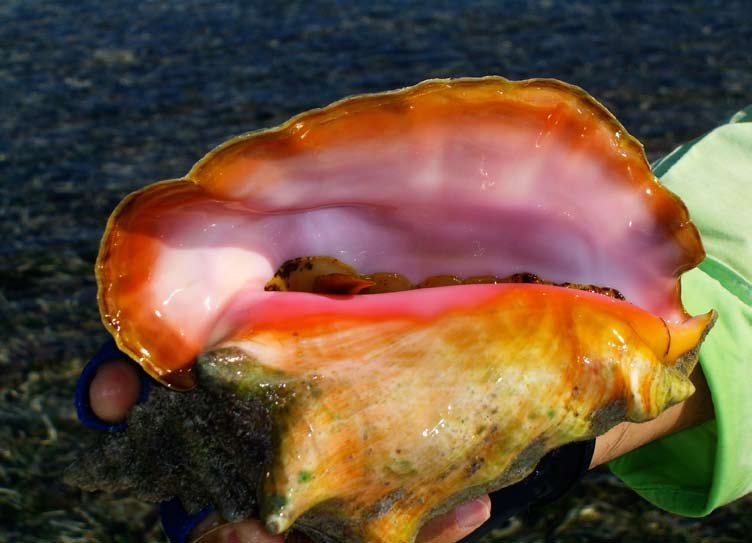
A queen conch shell is big enough to hold in two hands. The first result from a laboratory developed with Fort Pierce scientists and installed on Eleuthera was small enough that a shell collector would hardly have recognized it. This spring, researchers there received queen conch egg masses and watched a first hatch. It was a milestone for a project joining Florida Atlantic University’s Harbor Branch Oceanographic Institute with The Island School’s Cape Eleuthera Institute in The Bahamas. The animals in that initial hatch were at the beginning of a much longer journey.
In a June 17, 2026 announcement, Florida Atlantic reported that the laboratory had been established in February and that the first hatch occurred in April. The university described the system as designed to produce as many as two thousand juvenile queen conch annually. Those figures have different meanings. One is a date on which researchers observed something at the site. The other is a design capacity for animals that have to reach a later stage. Mixing them together would make a good headline and a very poor account of the work.
A collaboration with two addresses
Harbor Branch is the Treasure Coast connection. The hatching took place on Eleuthera. On the island, the Cape Eleuthera Institute supplies a local scientific and educational home for the work. The project has support from Chef José Andrés’ Longer Tables Fund. The Bahamian partner’s account is worth reading alongside Florida Atlantic’s. A story told only through the Florida address can leave the impression that Florida researchers are sending finished conch to an anonymous destination. The actual achievement involved people at the receiving site caring for animals and recognizing a biological milestone there.
One reason the word mobile matters is that the laboratory can go to a community. The shellfish do not need to travel to Fort Pierce for every part of a project inspired by research here. That changes what local participation can mean. Students can encounter multiple stages across time. Someone on site can see a change in an individual cohort rather than only a shell or a photograph that traveled back from another institution. A working space on the island turns a distant scientific connection into something people there can observe directly.
The early animal lives in a different world
The adult queen conch is a large marine snail. In the shell picture so many people know, a flared lip spreads outward from the opening. Early in life the animal spends time as a small, free-floating larva. For part of its life, then, a conch’s surroundings and means of moving through the ocean bear little resemblance to the adult animal on the bottom. An egg mass hatching and a juvenile living successfully on the seafloor are genuinely different events. Calling both baby conch is fine in conversation but obscures the questions the researchers have to answer.
Look at that difference from the perspective of a survey. A person looking down from a boat in clear water might see conspicuous shells. That same person could overlook an entire cohort in its drifting stage. Conversely, a count of larvae tells little by itself about the number that will settle in suitable habitat and eventually reproduce. Counts become interpretable when they come with an age or life stage, a method and a place. Two researchers reporting quite different numbers could both be accurately describing the same population at different moments in its life.
NOAA Fisheries’ queen conch account describes another complication. Adults need to be sufficiently close to one another to meet and mate. A region can still have conch scattered across it while local groups are too sparse for easy reproduction. Imagine a survey that finds the same number of adult animals in two stretches of seabed. In one stretch the animals are near enough to encounter each other. In the other they are spread across a much larger area. One total, displayed in large type, would conceal that difference. Density and distribution help explain why the same count can describe very different prospects.
An island can be connected without a single adult leaving home
The larvae also make this a Caribbean story. Water carries them before they settle. NOAA describes scientific work modeling how currents connect conch populations across different jurisdictions, alongside field and genetic studies to check those connections. On a political map, an island’s boundary stands still. On a map of larval movement, what happens at one location may matter to waters beyond it. Establishing those links takes more than noticing that two islands look close together on a chart.
This is one reason to be precise about claims of recovery. A laboratory can document hatching. A nursery can report how many juveniles reached a specified size. A field team can revisit an area, estimate density and look for mature animals. Accomplishing the first makes the second worth attempting. It cannot substitute for observations of the third. The strongest follow-up to the first hatch will be a series of clearly described outcomes, each taken at the place and stage where it can be measured.
For a Treasure Coast reader interested in the institution just north of Fort Pierce, a useful way to follow the project is to look for verbs in its updates. Hatched says an egg produced a larva. Raised identifies time spent growing under care. Released identifies a transfer into the environment. Observed breeding would describe something further still. A story can celebrate any one of these achievements without assigning the animals the successes of stages they have yet to reach.
Even the word shell carries two meanings here. A museum can preserve a shell for a century and document an animal that once lived at a locality. In a nursery an occupied shell is a record of an animal still growing, feeding and responding to its surroundings. Only the second sort of record can tell a project how a cohort is doing this week.
There is an appealing reversal in the work. For generations, an empty pink shell could be carried a long way and still stand for the whole animal in someone’s imagination. The Eleuthera project asks observers to follow the living animal long before it produces that recognizable shell, and long after its first successful day in a laboratory. The Fort Pierce connection is a piece of equipment and a body of expertise that traveled. The April hatch belongs to the people who witnessed it on the island, and the most interesting chapter is what those animals do next.