A Friday With the Refuge Volunteers or a Morning With Audubon? Two Ways Into Winter Birding
Find the Friday volunteer hours at Pelican Island National Wildlife Refuge, learn how local Audubon trips work and choose a winter bird outing near Vero Beach.
Someone with a free half hour on a Friday and someone ready to leave with a birding group early in the morning are looking for different outings. In Indian River County they also have different invitations. The U.S. Fish and Wildlife Service lists free Friday meet-and-greets with volunteers at Pelican Island National Wildlife Refuge into late December 2026. Pelican Island Audubon Society, a separate local organization, arranges field trips led by volunteers who ask participants to register and show up in time to leave together.
The distinction matters the moment a visitor enters “Pelican Island” in a phone. A refuge trailhead sits off the Historic Jungle Trail on the barrier island near Sebastian. The Audubon Society’s physical office is on Oslo Road in Vero Beach, and its trips can go to a variety of field sites. The organization’s name alone tells you little about where a particular group will actually stand. Look for the invitation that fits the kind of morning you want.
What a Friday visitor can do
The refuge specifies the Centennial Trailhead, on the west side of Jungle Trail Road roughly seven tenths of a mile south of State Road A1A. The meet-and-greet is listed for Fridays between 10:30 a.m. and 1:30 p.m. with no reservation. The Fish and Wildlife Service makes the appearance subject to volunteer availability, weather and holidays. Particularly late in December, a group traveling solely to meet the volunteers should verify the day with the refuge at 772-581-5557. The program describes a period when you can show up and talk, not a promise that a walk departs every hour. Refuge visitor information and program notices
A good question for the trailhead is one that can change a walk. Ask where volunteers have recently been looking for pelicans, what to watch for from the end of the boardwalk or whether the birds being reported are flying past, feeding or gathering in a particular place. Those answers tell a beginner where to stand and how long to wait. They can also distinguish a bird the volunteer actually saw that morning from a species the refuge supports at this time of year. Both are useful pieces of information, but they make different promises for a child eagerly holding a pair of binoculars.
The Service identifies migratory white pelicans and nesting brown pelicans among the birds visitors may encounter from fall into spring. Seeing one doesn’t guarantee seeing the other. If you have a relative who recalls the island as a brown pelican nesting place, ask the volunteer how that history fits with the large white birds a winter visitor may be hoping to see. It turns two entries in a bird guide into a question about what the same protected stretch of lagoon provides at different times of year.
An organized trip has a departure time
Pelican Island Audubon Society describes its volunteer-led field trips as generally free and open to the public, unless a specific listing says otherwise. Its instructions ask each participant to sign up on its website and arrive ten minutes before the announced start. The leader uses that interval to organize the group and then leaves on time. A visit arranged on the assumption that everybody can simply catch up at a trail junction can put both the visitor and the leader in a difficult spot. Audubon field trips, sign-ups and cancellation details
Read the departure and field-site information as separate entries. The society specifically asks people who expect to meet the group at the site to notify the office or trip leader. If your plans change, give up the space as early as possible so someone on the waiting list has a chance to take it. For a person who has never joined an organized outing this may sound surprisingly formal. Picture a leader watching the clock beside a group that is ready to go, trying to decide whether the last two people on the list are parking or are already miles away at the viewing spot.
At the site, a beginner can make a surprisingly useful contribution by being exact about what they saw. “On the lowest bare branch, left of the fork” can be enough to get the rest of a group on the same bird before it moves. Guessing at a name while everyone searches different treetops can lose the moment. When someone else finds it first, ask how they eliminated a similar species. Over a morning, those brief exchanges can add up to a lesson in looking that lasts well beyond the day’s species list.
The tram is a third invitation
The Service also describes free volunteer-led tram tours of refuge trails and viewing platforms during the colder months. This is its own program. The November-to-March seasonal description is useful background, while the refuge is the source for a particular tour’s hours, meeting point, current availability and access arrangements. A person planning around a ride should confirm those details before traveling. An invitation to chat at the Centennial Trailhead does not reserve a seat on a vehicle. Refuge guided programs and contact information
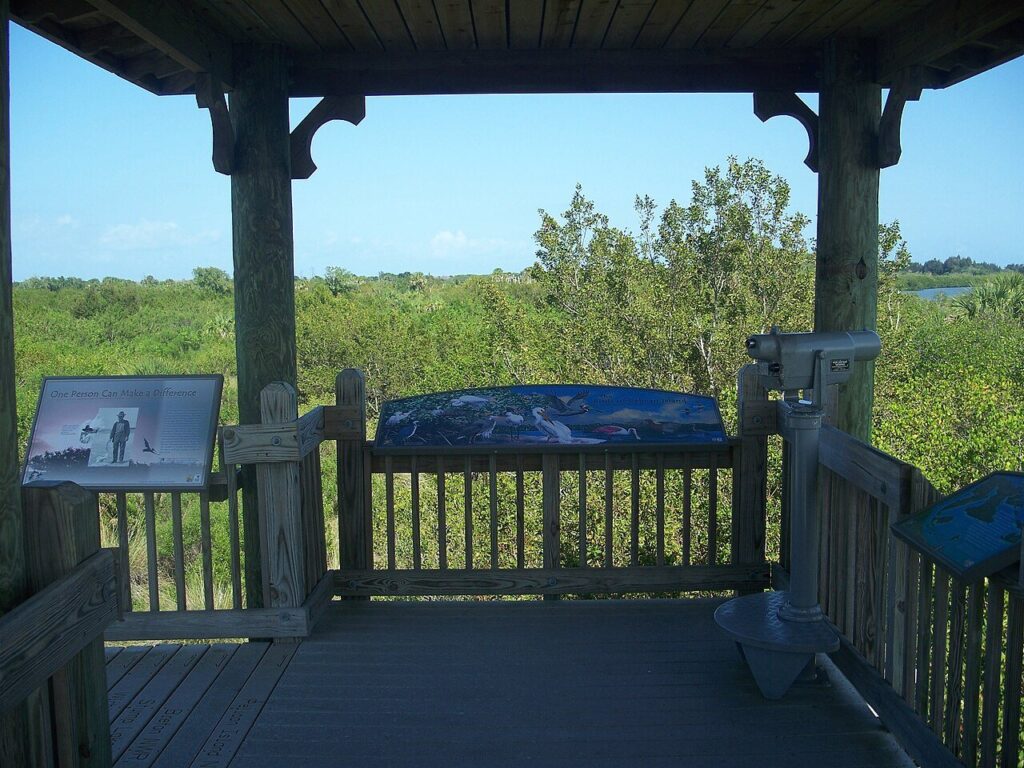
Visitors going at their own pace can use the interpretive signs or scan the self-guided iNature Trail codes along the Centennial Trail and boardwalk. For a family with different levels of interest, that offers a pleasant compromise. Someone can spend time listening to a volunteer and looking at the pond while another reads about the history behind the refuge system. The boardwalk itself carries a historical record. Its inscribed planks identify national wildlife refuges and their establishment dates, giving a group something very particular to look for even when few birds are visible. Fish and Wildlife Service historical timeline
The question to ask at the end of either outing is where to take the interest next. The Audubon Society invites people who know a good birding place to contact the office about leading a walk. The refuge has its own volunteer opportunities, which vary with season and need. Someone who starts by asking another person where to look may eventually have a favorite patch of water, and an answer, to share with a newcomer. Getting involved at Pelican Island National Wildlife Refuge