The reason a Vero Beach brewery has a power-plant flywheel
A surviving generator, an exposed flywheel and a roof lost in the 1928 hurricane reveal the working life of the old municipal power plant in downtown Vero Beach.
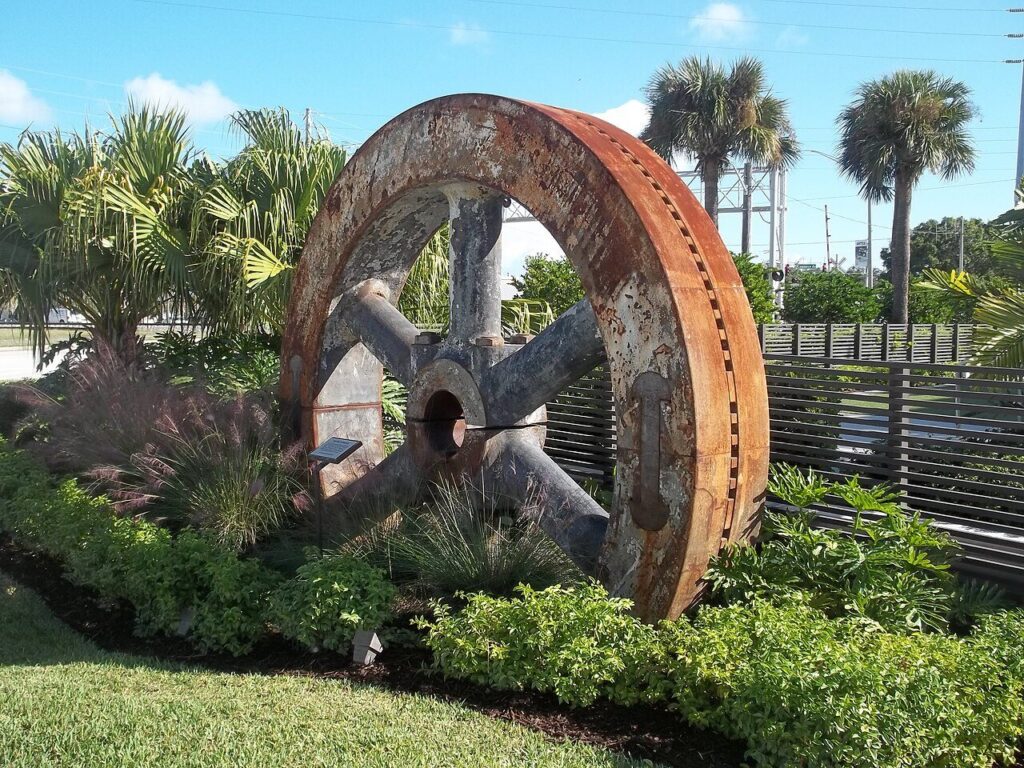
A flywheel makes an unusual piece of street-side sculpture. Its proportions come from a job, not from the spot where someone eventually decided to put it on display. A turning mass can store energy and help smooth the uneven delivery of power from an engine. Stand beside the flywheel associated with the old Vero Beach diesel plant and it offers a rough measure of the work that once went on inside the brick building. The structure now houses American Icon Brewery. Before it was a place to sit down for a meal, its continued operation mattered to almost everyone who turned on a light in town.
Two dates untangle the history. The municipal plant opened in 1926 with three operating engines. The surviving 750-kilowatt Busch-Sulzer unit was added in 1937. The machine visitors associate with the building today is therefore evidence of a growing system rather than the exact equipment people would have seen on opening day. The difference matters. A town that electrifies itself once still has to find a way to keep up with new homes, businesses and services. A machine added eleven years later tells a story about the demands that followed the first success. American Icon’s preservation account
Why the city needed a room this size
The historic nomination links greater demand for electric power to Vero's growth, including expansion to the barrier island. It locates the plant on a two-acre site in the downtown district, amid the railway infrastructure and commercial activity of a developing city. The structure is one story, but “one story” gives a misleading impression of its scale. The survey measured ceilings ranging from sixteen to thirty-five feet and a total area of more than twelve thousand square feet. An industrial machine needs clearance above and around it. A person assessing the room for a social use sees a very different set of opportunities in the same volume. National Register nomination
There is also substantial structure beneath the floor. The survey describes poured concrete and pilings extending about thirty-five feet. Much of the investment in this building was thus out of public view even before mechanical equipment arrived. A street photograph catches brickwork and belt courses; it does not catch the problem of supporting a heavy engine that does its work while running. Industrial architecture rewards this kind of reading. A wall, footing or open interior space can be a response to the weight, movement and maintenance needs of particular machines, quite apart from what a designer wants the outside to look like.
The flywheel provides a useful contrast to the electrical rating. A number expressed in kilowatts describes power. It cannot tell you what the generator looked like, how much room it occupied or what it took to install it. The physical wheel does almost the opposite. It gives an immediate impression of diameter, mass and the need for a considerable machine without telling a viewer how much electric power the unit could supply. Taken together, the plate or label and the relic give a visitor two independent ways to understand the scale of the installation.
The roof that taught a costly lesson
The National Register researchers recount a decision made during construction. Original plans called for a reinforced concrete roof, but a wooden one was used to bring costs in line. In August 1928 a hurricane tore away roughly a third of it, exposing generators to damage. Repairs finally brought the reinforced concrete slab the plans had originally specified. A seemingly modest adjustment to the construction budget thus had consequences for the equipment beneath it. The storm's history can be read in an element most visitors to a brewery would have little reason to examine.
A roof on a municipal plant plays a different public role from one over a private storage shed. The value at risk includes the machines inside but also the work everyone expects them to do the next day. In a town relying on these engine rooms for electricity, damage at one site could have effects well beyond its property boundary. That relationship between a single point on a map and many households across a town is part of what makes the storm episode worth preserving. A hurricane story that names only the amount of roof lost misses the significance of where it fell.
Reading an industrial room after its job changes
American Icon credits local preservation advocate Ruth Stanbridge and the Indian River County Historical Society in its account of saving the structure. The eventual conversion also had to answer a question that faces many disused public buildings. Once the original job has gone elsewhere, who has a reason and the resources to keep the doors open? The remaining engine was large enough to shape the design of a new interior. Making it a centerpiece allowed something of the room's original scale to remain legible even as people began using the space for an entirely different purpose.
For an architectural visit, compare three layers of evidence. The brick enclosure and tall volume belong to the plant itself. The surviving generator and associated components document the machinery installed during its working life. The arrangements for seating, service and circulation answer the needs of the later business. Some views or fittings may change with commercial operations. The decades-old registration document describes the building as it was examined for preservation, while the operator’s account explains later decisions. Reading the two side by side is more revealing than treating either one as a timeless description of the place.
A useful question for a child looking at the wheel is what it would take to replace a component of that size inside a crowded room. That shifts attention from the wheel itself to the working space around it, including the height needed overhead and the route a replacement part would need to follow.
The street address is 1133 19th Place. Anyone planning to visit the interior should check the business’s present arrangements. The exterior flywheel is a reminder that a museum case is only one possible place for local history. A wheel that used to operate within a larger mechanical system can now lead a passerby to a surviving engine, a city utility decision, a storm and the people who chose to save an unconventional building. Its size draws attention. The reason it was built that way is what makes it worth a second look. Operator’s location information