Two boats and a $9,625 proposal explain how a derelict vessel leaves the lagoon
An Indian River County grant application separates an abandoned-boat report, removal authorization, contractor pricing and state reimbursement.
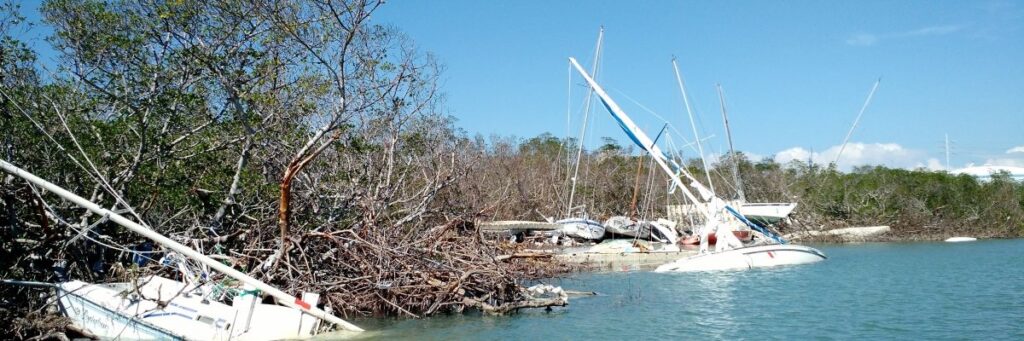
A boat sitting low in the Indian River Lagoon can be visible to hundreds of people before anyone watching from shore knows its legal status. Is someone aboard? Has the owner arranged repairs? Has an officer investigated? Has the county engaged somebody to remove it? These questions refer to different moments. In an August 2025 request involving two lagoon vessels, Indian River County staff documented a point between a determination that the boats could be removed and the financial steps needed to get the work done.
The county staff memorandum for file 25-0860 reported that state officers had investigated and authorized removal of two vessels. A maritime contractor proposed $9,625 to remove and dispose of them. The county had that amount available in a boating improvement account and wanted authorization to submit a state grant application. Read in order, the facts describe a functioning process. They do not establish that the contractor had already been paid, that the boats had already disappeared or that the state had issued a reimbursement.
From an observation to an authorization
The county’s Lagoon Division project page describes its work with state wildlife officers on the lagoon and St. Sebastian River. It provides a channel for the public to report a possible derelict vessel. That is an opportunity to communicate a location and observable conditions. It is particularly helpful when a person can distinguish a boat they recently saw from a photograph passed along without a date or a precise position.
A resident need not decide whether the legal definition applies. A vessel may appear weathered without being abandoned. A vessel recently damaged in a storm may have an owner already coordinating assistance. The county describes investigation, efforts to locate and notify an owner, a notice placed on the vessel and authorization before removal. An officer’s report is therefore a different kind of record from a bystander’s photograph. Each can provide information, but only the agency’s process resolves the official status.
The Florida Fish and Wildlife Conservation Commission’s removal grant program gives another reason to keep the steps straight. Among its requirements for eligibility is an opportunity for the vessel owner to challenge the determination. The agency describes an ongoing application process while funding is available and reimbursement for eligible vessels covered by the grant contract. An owner’s opportunity to respond and the public’s interest in a navigable waterway both figure in the process the state is prepared to fund.
Why a reimbursement grant needs a local budget line
A promise to reimburse eligible expenses changes who ultimately bears a cost; it does not eliminate the sequence of transactions. Someone must engage a contractor and document an eligible removal. Someone must review the bill against the agreement and submit what the state requires. A reimbursement follows the documented expenditure under the program’s terms. That is why the 2025 memorandum could identify available county funds at the same time that it sought state assistance for the project.
The $9,625 quoted for the two boats is a proposed project price. Dividing it by two yields an average of $4,812.50, but the memo does not establish that either individual vessel cost exactly that amount. Boats can differ in size, position, condition and the work needed for disposal. A contractor can also mobilize equipment for more than one job. To compare the costs of two removals, a reporter would need the scope and the detailed prices or invoices, along with information about the circumstances each covered.
The county’s request also illustrates why a meeting date or staff signature is not a substitute for a completed contract. Staff requested authority for the chair to execute the grant application and for the county administrator to sign contract documents if funds were awarded, with legal concurrence. Both a future decision and a condition appear in that sentence. A later story about the work should identify the award or executed agreement and the evidence of completion instead of presenting staff’s recommendation as the last stage.
What the water looks like after the paperwork
Residents care about visible outcomes for good reasons. The county lists potential damage including navigation hazards, loose debris, pollutants, harm to shoreline and underwater habitat and entanglement risks for animals. Which impacts occur depends on the particular vessel and its location. A boat’s disappearance from one familiar anchorage does not establish that it was properly disposed of. A completion report, disposal documentation or contractor invoice tied to the case can establish a stronger account of what happened.
People may also ask why one boat appears to go before another. The most informative comparison begins with the status of the two cases. Has either received authorization? Does each meet the grant criteria? Are they in the same body’s jurisdiction? Is there an owner able to act? These questions leave room for an actual delay or problem to be identified. Ranking cases solely by how long each vessel has appeared in photographs overlooks the work that distinguishes an investigation from a removal ready to proceed.
There is also a route designed to keep an at-risk vessel from getting this far. The county points owners who have received a qualifying written warning or citation toward Florida’s vessel turn-in program. A voluntary disposal and a county-authorized derelict removal might produce similar photographs at the end, yet they have different histories. For a fair public count, ask which categories the county reports, which time period it uses and whether a state-assisted turn-in appears in a county project total.
The two-vessel memorandum is valuable because it freezes the process at a particular point. Officers had made their determination, a contractor supplied a price and local staff sought financial authority for the next step. The missing records for a retrospective account are specific and findable: an executed funding agreement, the completed work, final expenses and any reimbursement received. Those make a better test of the program than either the initial sight of a damaged boat or the reassuring round number of a state grant.
There is one other detail worth preserving in a public project list: the waterway named in the case. The Lagoon Division works on more than one body of water. A year’s total for its entire program can be accurate and still overstate removals from a particular stretch of the Indian River Lagoon if the geographic scope disappears from a chart.