What the funding requests and construction bid tell us about Humiston Boardwalk
The public record of Vero Beach’s boardwalk replacement spans a state funding request, a city bid and a contract award. Each puts a different number in context.
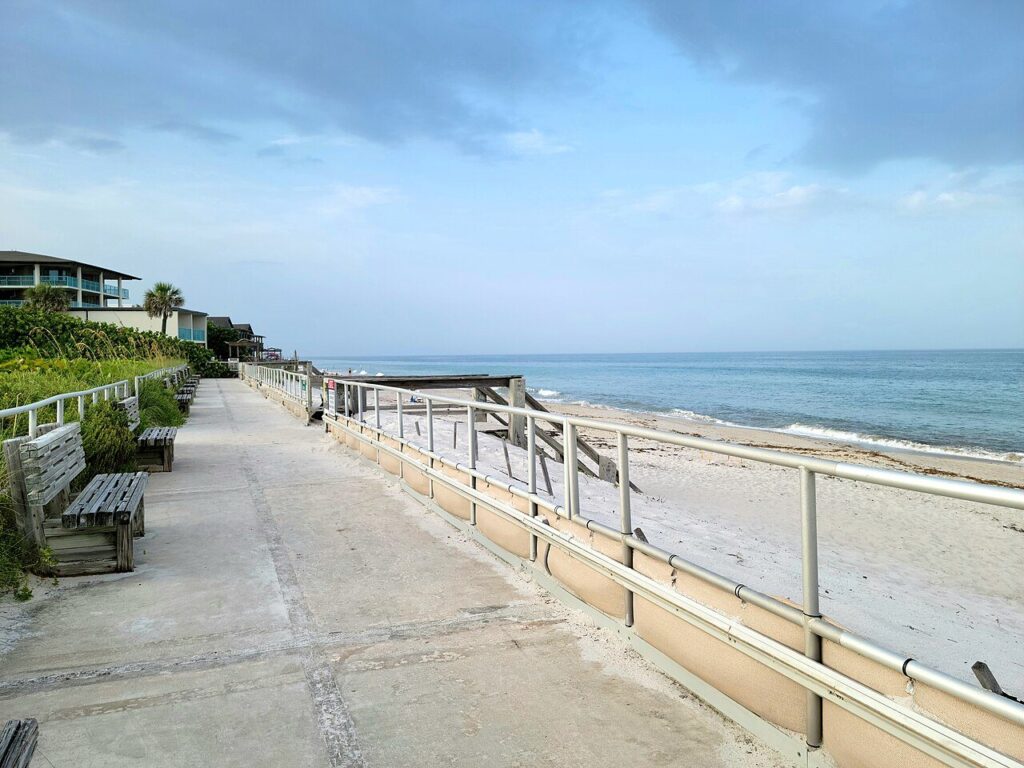
A person who wants to know how much Humiston Boardwalk costs can find multiple answers without leaving the public record. A request filed with the Florida Senate asks for state money. A separate procurement describes the construction the city wanted bidders to price. Accounts of the City Council’s August 2026 decision report the award of a construction contract. Each figure belongs to a particular point in the effort to restore a Vero Beach oceanfront landmark. They do not all measure the total cost of putting a usable boardwalk back at the park.
The state funding request for fiscal year 2026–27 describes the damage from Hurricane Nicole in 2022 and identifies engineering, design and capital construction as intended uses. It seeks $700,000 from the state. That is a valuable historical fact even if a reader does not yet know the final disposition of the request. The form identifies an applicant’s stated need. Establishing whether the state ultimately supplied money, and how much it actually paid, requires additional records.
Why the bid tells a different story
The city’s listing for boardwalk replacement bid ITB-110-26-DK concerns work described in the construction documents. Its status text identifies a staff recommendation involving Ferreira Construction. That number and vendor name give readers a precise way to find the council action and any later amendments. They also mark a change of perspective. An appropriations request describes how someone hopes to fund work. A bid describes what a contractor offers to do under a defined set of requirements.
WQCS reported on August 26 that the council had approved a construction contract and that fundraising was still under discussion. Vero Beach 32963 subsequently identified the August 25 meeting and placed the contract at about $1.76 million. A funding shortfall quoted during that period has a date attached to it. It would take a newer accounting to say what remained to be raised at a later point. The fact that an old appeal is still online cannot settle that question.
Put sources of money alongside uses of money
A useful way to read the project’s finances is to divide a sheet into two sides. On one side put the parts of the job, including design, permitting, construction, oversight and any work outside the main builder’s scope. On the other put sources such as city funds, assistance from another government and private donations. The Senate request itself anticipated assistance from Indian River County, FEMA and donors. Anticipated assistance belongs in a different column from money received or an executed reimbursement agreement.
Consider how the same dollar could appear in more than one place. The city might make a payment for eligible work and later receive reimbursement from another agency. Adding that reimbursement to what the contractor was paid would overstate the cost. It is a source covering a use. Conversely, subtracting a desired private contribution from the total as if it were already in hand could make the local funding need look smaller than it is. A summary that includes dates, status and restrictions gives taxpayers a clearer picture than a single running total.
The park user’s question is about access
For someone who uses Humiston, the practical milestone is when the facility or a particular section becomes available. Engineering completion, contract award, a ceremonial start and opening to the public can occur on separate dates. A contractor can also finish one element while another party has responsibility for inspection or adjacent improvements. A family heading to the beach should rely on a current notice about access or restrictions. A news story about the contract award does not establish which route is available today.
When examining a construction update, ask whether it concerns the structure itself, the approaches or the rest of the park. A photograph of workers at one point says little about conditions at the opposite end. A description of future access improvements should be compared with the plans and the accepted scope. Asking which entrance, surface or connection an update covers is often more productive than asking whether the entire park is on schedule. It also yields information that a person with limited mobility can actually use.
Is a fundraising target the same as a public obligation?
A donor program can supplement a public project while bringing its own details to the record. Minutes from a May 26 council discussion include ideas about recognition of contributors. Someone reading about engraved elements would reasonably want to know whether a contribution has been pledged, received, designated for a particular feature or credited against construction already funded elsewhere. Those distinctions are relevant to project accounting even when everyone agrees on the value of restoring the boardwalk.
They also matter to a donor deciding what a contribution supports. A late gift might pay for an amenity, reduce the amount supplied from another source or support a future maintenance need, depending on its terms. Those possibilities should be checked against the actual program before promising a donor an outcome. Public recognition is itself a design and operations question. Which components can carry it, who approves the text, and what happens when an element needs to be replaced? The answers belong in the program terms or a subsequent decision.
The numbers worth collecting at closeout
A complete account will show the accepted construction price, approved changes, payments for related professional services and the actual financing shares. The final sum should explain any difference between the broad project and the specific construction contract. The state’s request form also proposed measuring benefits through counts of park users. A future comparison would need to say how visitors were counted and over which period. A sunny holiday weekend and a week with partial closures provide very different denominators.
That leaves two straightforward questions for different audiences. A taxpayer can ask what the city paid after eligible reimbursements and donations. A park user can ask what opened, where and when. The documents described here show why both questions deserve dates and separate answers. The most informative update will tie the money to the piece of boardwalk people can actually use.
Keeping the bid identifier with those answers also helps years later. A resident looking into a repair can distinguish the original replacement contract from maintenance carried out after the city accepted the work. That small detail can save a long search through records for entirely different beachfront facilities.
The park location and the year of the award are especially helpful when a later contract includes several coastal sites under one title.