What a Fort Pierce boatyard gave the paintings of A. E. Backus
Explore a Fort Pierce painter’s boatyard beginnings, his changing use of paint and the distinct achievement of the Florida Highwaymen he influenced.
Albert Ernest Backus had an unusual place to learn what oil paint could do. His family operated a boatyard in Fort Pierce. According to The Johnson Collection’s artist biography, he experimented with watercolors as a child and learned about oil-based paints in his father’s shop. The boatyard later served as his studio. In a town where work on the water was a livelihood, one of Florida’s best-known landscape painters developed some of his knowledge of paint where boats were being maintained.
A useful way into his work is to set aside the question of whether a picture looks exactly like a particular bend in the river. Ask two questions instead. How did a painter use a physical substance to convey light? How did a painter working in Fort Pierce make a living and influence people around him? The first question leads into a canvas. The second puts it back in a town with trades, clients, education and unequal access to markets. Both help explain why this is a rewarding day trip for someone who sees the Indian River on the regular drive between Vero Beach and Fort Pierce.
Training beyond the classroom
Backus was born in Fort Pierce in 1906 and died in 1990. He is regularly described as largely self-taught. The Florida Artists Hall of Fame records limited formal training in New York. The Johnson Collection identifies two summer sessions at Parsons in 1924 and 1925. He also did commercial sign and billboard work and worked in association with Fort Pierce’s Sunrise Theater. Those activities belong in the same artistic education. A picture intended to work at a distance or on a deadline presents problems different from the ones in a classroom.
Imagine lettering a sign where the spacing looks right up close but the letters run together across the street. The painter has to move back, look again and revise. A distant cluster of trees in a landscape poses a related visual problem. Too many equal marks can make the mass look fussy. Very few marks can suggest great complexity if the value and shape are convincing. This is an analogy about visual work, rather than evidence that a particular billboard led to a particular painting. It helps explain why a local craftsman’s working experience is worth taking seriously in the life of a painter.
Looking at the substance on the surface
The Johnson Collection describes thick, knife-applied paint in a period of Backus’s work after World War II, with greater detail and smoother surfaces in later work. Think about the difference between those approaches. A ridge of oil paint catches actual light from the room as well as representing light within the painted landscape. On a screen the ridge may register only as a small mark. From a suitable distance in a gallery, it may contribute to the whole impression of a sky or bank of vegetation without demanding that anyone count individual strokes.
For a first look, choose one edge where water meets land and follow it across the picture. Does the boundary remain equally sharp all the way across? Is there a place where one color becomes hard to distinguish from the next? An artist can direct attention by changing only a few inches of that edge. Then compare the distribution of detail in the foreground with the far shore. These are experiments in looking that work with many paintings, including the River Landscape linked from The Johnson Collection’s biography. The online record gives you an example to study before traveling, without implying that particular painting hangs in Fort Pierce.
A studio could open a door
The Fort Pierce story extends beyond Backus’s own career. The Smithsonian’s account of the Florida Highwaymen connects Backus to Alfred Hair and other artists including Harold Newton. Its subject is the economic and artistic agency of the Black painters who became known collectively as the Highwaymen. They found ways to make and sell Florida landscape paintings during and after segregation. A studio relationship is an important part of that story, but it cannot stand in for the decisions that each artist made about production, subjects and how to reach buyers.
Pay attention to names when reading labels. A picture by Mary Ann Carroll belongs to Carroll’s individual career as well as to the history of the group. Hair and Newton should not become interchangeable illustrations of a single style. The state’s Hall of Fame entry for the Highwaymen emphasizes their individual techniques. When you compare two Florida landscapes, begin with the compositional decisions you can see rather than assigning either picture to an individual by a palm, a sunset or a familiar shade of orange. A subject can be shared while the treatment remains distinctive.
The way a picture reaches its audience
A canvas viewed behind a museum label once had a life before the label was printed. The Highwaymen’s direct sales took paintings to buyers outside the conventional gallery system. The scale of a work, the time needed to finish it and its impact on a person encountering it briefly can all matter to an artist selling directly. This context makes speed a subject worth thinking about carefully. An economical mark that reads immediately as a tree is still a decision about trees and paint. Treating a quick sale as the whole explanation for a finished picture overlooks the skill necessary to make the sale possible.
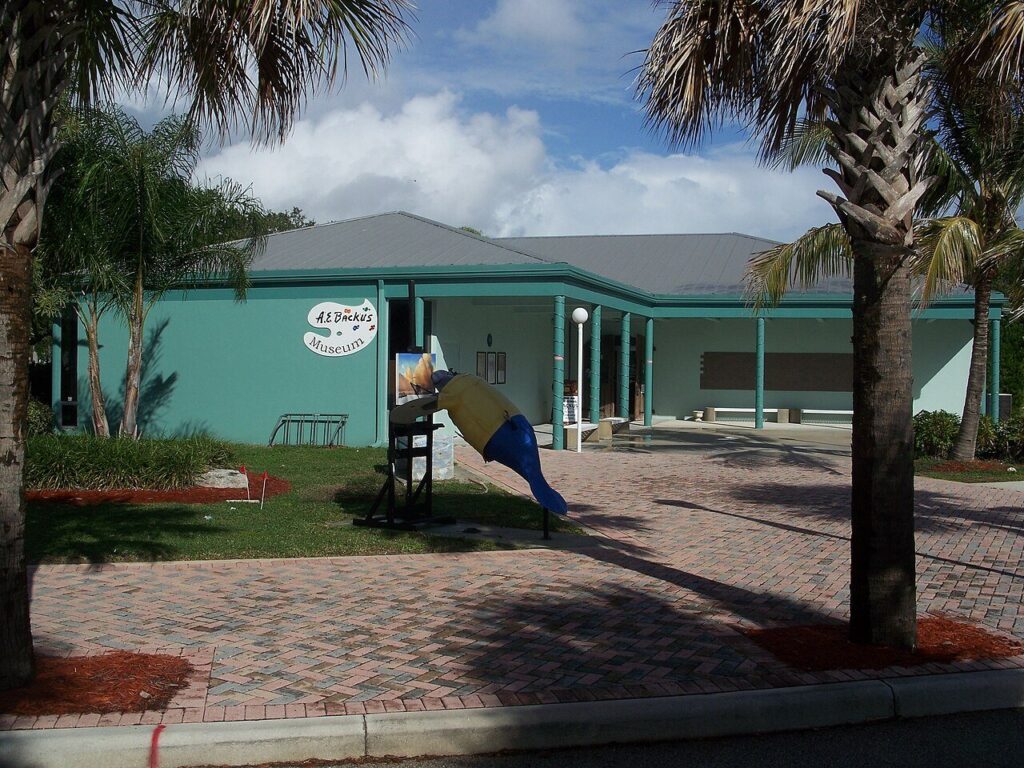
At the A. E. Backus Museum & Gallery on North Indian River Drive, check the current exhibition before setting out from Vero. The museum also describes an outdoor mural presentation, offering another chance to think about pictures made for a different scale and audience. If you have time after the galleries, look at the actual division between water and sky outside for a minute. Ask which few changes of color or contour you would choose if you had to make a small picture of it before the light changed. You do not need to own a brush to find that a surprisingly technical problem.
What the boatyard contributed was more than a picturesque origin story. It places a widely recognized artist within the working life of a Florida town and asks viewers to take his materials seriously. Add the quite different careers that intersected with his studio, and a painting of a familiar landscape becomes an opening into the history of who could learn, sell and be seen in Fort Pierce.