At the Sunrise Theatre, a Highwaymen Art Show Comes Before the Film
The free December 28 premiere of Sunrise City pairs a 4 p.m. lobby art show with a 7 p.m. documentary. Follow the artists’ story into Fort Pierce’s Lincoln Park.
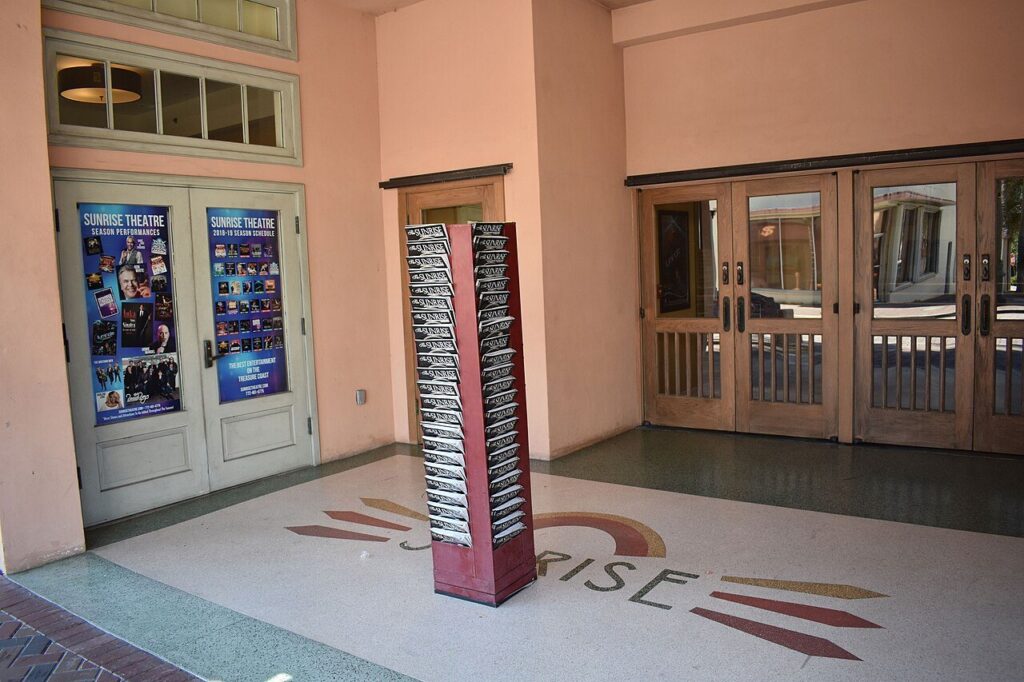
The first thing to decide about the December 28 premiere at the Sunrise Theatre is whether to arrive three hours before the movie. That would be a strange recommendation at an ordinary screening. Here it makes sense. At four in the afternoon, artists will be in the lobby for a Highwaymen art show. At seven, the filmmakers present their documentary, Sunrise City – The Florida Highwaymen Legacy. The time between those two appointments is a chance to meet people who paint and sell Florida landscapes now, before watching a film about the generation that made that livelihood possible.
The Sunrise lists this as a free community event on its main stage at 117 South Second Street in Fort Pierce. Its official event page has a registration link. Use the December 28 listing when arranging a visit or sharing it with someone else. The theater’s Black Box has its own schedule, and a ticket to another show in the same building will not organize this evening for you. Sunrise Theatre event information and registration
What the name gathers together
The Florida Highwaymen are 26 African American landscape artists associated with Fort Pierce. In the days of segregation, artists who had little access to gallery representation developed ways to sell their paintings directly. The city traces the movement to the 1950s and notes that all 26 artists entered the Florida Artists Hall of Fame in 2004. Those two dates belong together. A gallery visitor today can look at the paintings as part of a recognized movement. A painter trying to make a sale in the middle of the last century had to find a customer for an individual picture.
That practical problem changes how you might spend time in the theater lobby. Suppose two visitors stop at the same picture, one close enough to see how the artist handled a tree branch and one several steps away. Each has access to something the other may miss. From a distance a sweep of sky can draw someone over. Up close, a change in brush direction can make two patches of foliage read differently. Move from one position to the other before asking the painter a question. It is easier to begin a conversation about an actual choice on the surface than to ask someone to explain an entire tradition.
An original work, a reproduction, an older painting someone owns and a recent painting made by an artist working today carry different histories. A question about who made a picture and when is welcome context even for a visitor who has no intention of buying. The theater describes an opportunity to meet modern-day artists, and the documentary looks back at the original group. The organizers have made room to think about both generations without asking a single painting to stand for everybody else’s career.
A woman on the trail
A city history project gives visitors a way to put a particular name into that conversation. In its account of Mary Ann Carroll, the city explains that her family moved to Fort Pierce when she was eight, that Harold Newton mentored her and that she sold her first painting at eighteen. She was the only woman among the original 26. The Highwaymen Heritage Trail places Carroll and Newton at Moore’s Creek Linear Park, at Avenue B and Tenth Street. If the names in the film are new to you, starting with two people who actually knew one another can be easier than trying to remember an entire roster. Fort Pierce Highwaymen Heritage Trail and artist profiles
There is a different kind of record at the intermodal station at Eighth Street and Avenue D. The city describes 26 engraved plaques set against a mosaic of a royal poinciana. On a museum wall, you might encounter one painter’s name beneath one composition. On this wall, you can see how many names a familiar collective term contains. Reading a few aloud or taking the time to find Carroll’s plaque is a way to make the list intelligible to children who are unlikely to remember a lecture about it.
What can fit into one afternoon
For a short December outing, the simplest pairing is the lobby and the screening. Put the art show time in the invitation if someone wants to talk with artists before taking a seat. For a visitor primarily interested in the documentary, share the registration page and the seven o’clock start. The theater gives a door time and a curtain time, but the listing does not promise a particular artist will be at a particular table until the last minute. Allow the conversation room in your plans if it is part of the reason for going.
For a longer investigation, put the new municipal Highwaymen museum on a different day. It sits at 1234 Avenue D in Lincoln Park. The city says its exhibitions include work by each of the 26 artists. That makes it an unusually revealing companion to a film or lobby conversation. Look for two different painters’ ways of depicting a familiar Florida subject. Does one organize a scene around a low horizon while another asks you to look into a dense group of trees? Does a road lead the viewer toward something or simply disappear? Checking the museum’s visitor arrangements separately keeps its hours distinct from the Sunrise’s evening program. City of Fort Pierce Florida Highwaymen Museum
Even someone who knows the familiar landscape imagery can take a fresh question into the screening. Think about the distance between where an artist worked, where a customer first saw the picture and where it eventually came to hang. Those changes in location helped shape who had an opportunity to see Florida art in the first place. By the end of this event another picture might make a similar journey, from an artist’s table in the lobby to a home somewhere along the Treasure Coast. Paying attention to the person handing it over is a fitting way to begin an evening about the people who found a way to sell their work themselves.
For a reader coming down from Indian River County, the two Fort Pierce addresses belong in different map entries. Second Street is the destination on the evening of the premiere. Avenue D is the destination for a later museum visit. That small distinction puts the right history in the right part of town.