Who ran the store in this old Vero photograph?
Use Indian River County directory extracts, newspaper indexes, photo records and maps to identify a Vero Beach business or test a family story.
An undated picture of a Florida storefront can come with an exceedingly confident family caption. Some version of “That was Aunt Helen’s father’s shop in Vero” may be all that survives. It is a starting point for an enjoyable local research problem. Which Vero, in which decade, which relative and which business? The Archive Center and Genealogy Department at the Indian River County Main Library has tools for each part of that question. Success sometimes means proving the caption substantially right. It can also mean discovering that a family remembered the right business and the wrong generation.
Before opening a database, write down exactly what the picture shows. Transcribe the letters that are legible on a sign, leave a blank for the ones that are not, and distinguish a painted window from lettering that may have been added to a later print. Record whose account supplied the family relationship. Photograph both sides if that can be done without removing the print from a mount. A forwarding address or a photographer’s mark may be more informative than a guess about the age of a car. Preserve the original caption even if later evidence gives you a better one.
First get the county right
The county’s guide to Indian River history files and indexes includes several records whose titles feature St. Lucie County or Fort Pierce. They belong in a Vero research project. Present-day Indian River communities appear within records organized under earlier boundaries. The guide identifies, among other things, a 1905 petition to St. Lucie County commissioners by residents of what is now Indian River County and extracts from a 1925 Fort Pierce directory covering towns in the present county. A search confined to record titles bearing today’s county name would miss both.
Begin with a broad time range and a place, rather than a birth year invented to make a search box happy. If the family knows that the picture came from a collection assembled before a certain move, record that fact as the latest possible collection date. It may not date the photograph. If a published directory identifies the business in a particular year, that dates the listing and gives you a year to investigate. It does not establish that the shutter clicked in that same year. Getting those two dates onto separate lines in your notes can prevent a lot of unnecessary correction later.
Try the work as well as the surname
The county guide describes a 1916 business directory organized by occupation. This is especially helpful when names are uncertain. If the window lettering looks like the end of a word for a trade, browse related occupational headings and write down all plausible names. A profession might have been described using language different from a modern search term. A surname heard aloud might be spelled several ways. The guide also points to an 1886 gazetteer extract and a 1914 voter list for communities now in Indian River County. Each source describes a different group of people for a different purpose.
That difference matters in practice. A voter list cannot produce an inventory of everyone who ran a business or lived above a shop. A business directory may identify a proprietor and omit relatives who did significant work there. A person remembered by a married surname in family oral history may appear in an earlier record under another name. Treat an unsuccessful search as a result tied to one collection, year and spelling. The county cautions that marks or obscured originals can defeat keyword searches of its PDFs. Browsing the pages around a plausible entry is a different operation from repeating the same search.
Put the photograph beside another photograph
Among the department’s finding aids is an index to thousands of Indian River County Historical Society photographs. An index is a path to an image, and images of two neighboring businesses can be more revealing than two pictures of the identical sign. Compare roofline, doorway spacing, adjoining buildings and the direction from which the photographer faced the block. A match in window design alone is weak evidence if several commercial buildings used similar fronts. A sequence of matching features with an independent place caption can narrow the field considerably.
The guide also identifies local maps, postcards, family files and an index of names and subjects across fifteen local history books. A postcard can be useful for block layout, although printed captions may simplify or generalize a location. A map can establish the relationship between streets without identifying the tenant of a particular storefront. A family file may direct you to another surname worth checking. Ask for references by their collection names and index entries. “I found this numbered photograph in the historical society index” is a much easier inquiry to answer than a request for everything about downtown.
When a name leads to a newspaper
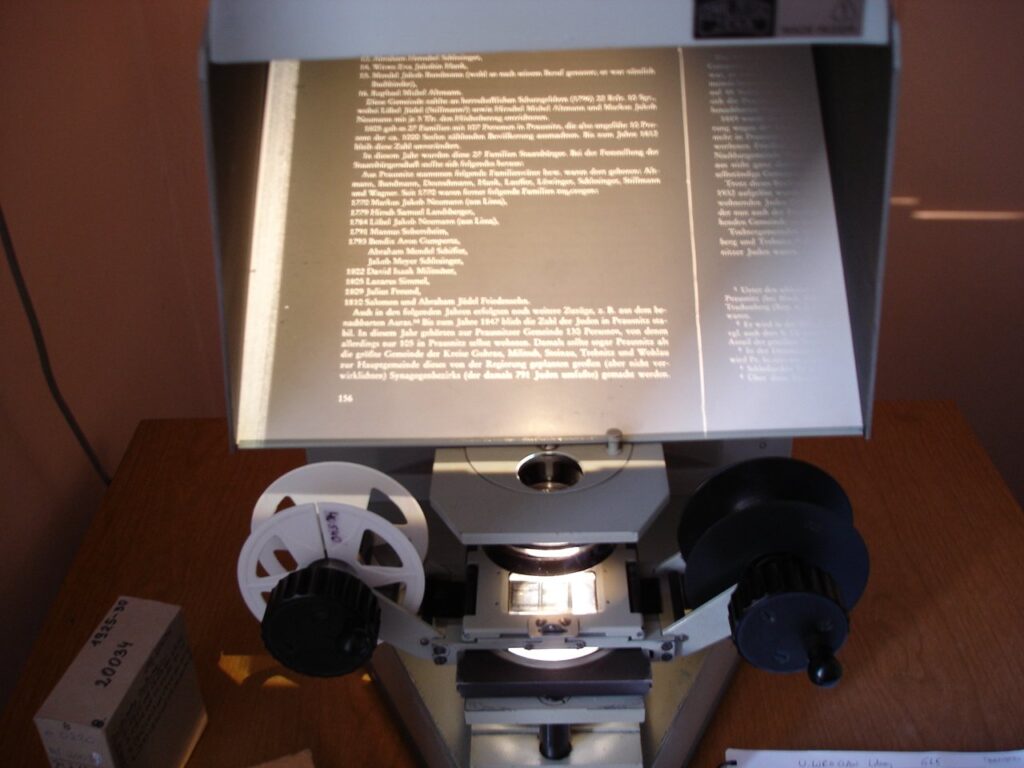
The Indian River Genealogical Society’s obituary lookup guidance explains that local volunteers and library staff have compiled entries from newspapers reaching back to 1913. Many underlying notices are held on newspaper microfilm. A newspaper notice identifying a relative’s occupation or family members can help distinguish two people with the same surname. Read the actual notice if possible. A date in an index may be a newspaper publication date, and the index may have a separate entry for each day the person was mentioned.
For a request, follow the society’s instructions on email or mail, provide the identifiers you have and respect its limit for a standard lookup. You might discover that a death notice has only a few lines. Those few lines can still anchor a name and publication to a date. They cannot establish that someone pictured outside a building owned the business inside. Keep the question about the building open until a business record, caption or other source joins the person to it. That small restraint is often the difference between a persuasive family history and an attractive guess.
Return to the original picture and write a new caption in two sentences. The first should state what you can identify and cite the record that supports it. The second can preserve what a relative remembered and anything that still needs checking. The Archive Center’s department page gives the current contact and visit information for the Main Library on 21st Street. Bring your notes as well as the picture. Learning how a particular answer was reached gives the next researcher something more useful than certainty alone.