What to look for after dark at McKee’s 2026 Jungle Lights
McKee’s Jungle Lights opens November 29 in Vero Beach. Discover the living tree, animal lanterns and historic landscape, plus four holiday closures.
Two trees in McKee Botanical Garden’s holiday program tell the story of Jungle Lights better than the number of lights ever could. One stands 30 feet high in red and white. A second, half its height, is assembled from 375 living bromeliads and orchids. One asks you to stand back and take in its outline. The other rewards a closer look at the pieces that make its outline possible. Both feature in the 2026 evening event, which opens November 29 in Vero Beach and runs on selected nights through January 2.
Count the nights before buying the tickets
The garden’s event announcement gives a 6 to 9 p.m. window and advertises 31 nights. It also names four evenings when the display is closed, December 24, December 25, December 31 and January 1. That matters especially to people building a family gathering around Christmas or New Year’s. January 2 is a scheduled evening. January 1 is not. A calendar entry that says simply “through January 2” misses the difference.
One of those 31 nights has its own restriction. Tuesday, December 1 is for members only, with advance tickets required. Public regular nights run through December 16 and premium nights begin December 17. On regular nights the model train is absent, so someone chiefly interested in that display should choose one of the premium evenings. The garden’s admissions calendar puts the train and holiday characters on that second part of the program.
The garden’s admissions page sets last entry at 8:30 p.m. That is an admission cutoff, and arriving then leaves half an hour before the stated close. It is a poor choice for somebody planning to see the model train with a child, spend time with the sculptures and make a stop at the café. The garden offers advance tickets until sold out and identifies sales as final. Before paying, compare the evening, number of people and ticket type against the invitation you sent the family. A familiar daytime admission routine is no substitute for checking the ticket for this special event.
Why the site matters after dark
The setting off U.S. 1 is a remnant of a much larger landscape. According to McKee’s account of its history, Arthur McKee and Waldo Sexton founded the garden in 1932. Landscape architect William Lyman Phillips of the Olmsted Brothers firm designed it to retain a Florida hammock while incorporating tropical plants from other places. The original attraction encompassed about 80 acres. It closed in 1976, and development took most of the property. Eighteen acres survived. Preservation work, including support from the Trust for Public Land, made possible the garden that reopened in 2001.
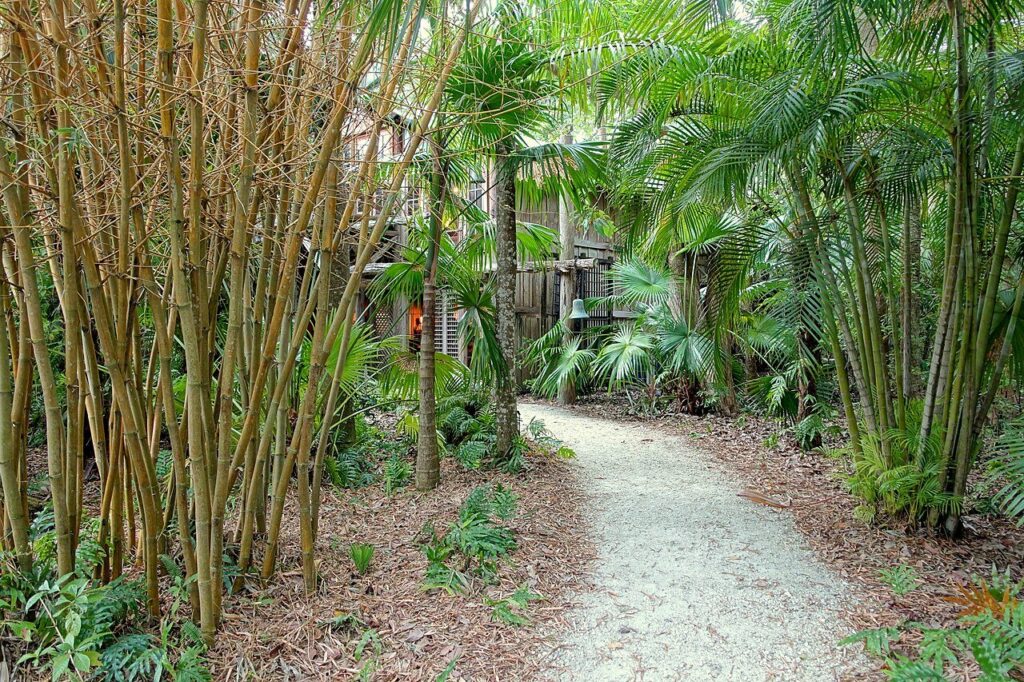
With that history in mind, an illuminated path becomes a way to see the bones of the place. Look beyond a bright object to the darker shapes around it. A canopy can form the ceiling of a passage; a turn can hide the next display until you pass it. Move a few feet and the relationship between the sculpture and the trees changes. It is worth trying this at least once with the phone down. A photograph can make lights in the foreground crisp while nearly erasing the depth that gives the path its shape.
Three kinds of animal share this garden
McKee describes towering animal lanterns drawing on Amazonia, sculptures of endangered African baby animals by Gillie and Marc, and a 16-foot Rudolph associated with its Great Reindeer Hall holiday display. Each belongs to a different imaginative world. An Amazonian lantern represents an animal through a luminous form. A sculpted baby animal comes from artists using an individual figure to raise a question about a species. Rudolph belongs to a holiday story. None of those labels tells you the animals live on the grounds in Florida.
Children can use that distinction without turning the visit into a science lesson. Let one person pick an animal made to glow from within. Have somebody else pick a figure whose surface catches the light from outside. Then step away until only the silhouettes are easy to see. Which animal can the group still identify, and what gives it away? For an adult interested in design, the same exercise shows how much rests on the curve of an ear, the length of a leg or the way a figure stands against the foliage.
The smallest scenery calls for a slower stop
The other change in scale comes with the large model train and its Swiss Alpine village. In a lantern display the visitor can look up at an animal taller than a person. At a model railway, a building or bend in the track can hide the train completely. Choose one stretch of track and wait for it to pass rather than trying to follow it around the whole scene. A child who finds movement easier to follow than a static sculpture might enjoy this more than the larger, brighter objects nearby.
The two trees offer a different comparison. Look at the red and white tree from enough distance to see its whole shape, then look at how the garden builds the surface of the living tree from individual plants. Both rely on repetition. One repeats points of light, the other repeats leaf forms and flowers. Someone who grows an orchid at home may find an arrangement of hundreds of plants more striking than the height of either tree. Someone looking for a picture of the whole family might prefer the larger outline as a backdrop.
Leave room for the parts that interest your group
McKee says its Garden Café will offer holiday treats and the Garden Gift & Book Shop will open. One item mentioned by the garden, a commemorative book about preserving the tropical landscape, gives local history readers a way to follow up on the grounds themselves. Decide before entering whether shopping or food matters to anyone. If both are optional, nobody needs to hurry a grandparent away from a sculpture or a child away from the train to make time for them.
For a visitor who needs information about distances, resting places or access after dark, describe the actual concern when contacting the garden. The important question may be whether someone can enjoy a useful part of the evening without walking the whole display, or how far the entrance is from a particular feature. Those are different questions from whether tickets remain for a given night. Choosing a night with enough time and the right people can do more for this visit than trying to see every light before nine.
For visitors who know McKee only by its holiday program, the garden lists daytime tours separately. A return visit in daylight would answer another set of questions, including which shapes were plants, what was water and where the path turned back on itself. The transformation works in both directions. In December a familiar garden can look unfamiliar. In daylight a spectacular evening backdrop turns out to be a collection worth seeing on its own.