The writer’s house that moved twice after leaving Wabasso
A Florida pine house links an international poet, a Wabasso citrus grove and the effort to keep a literary landmark accessible in Vero Beach.
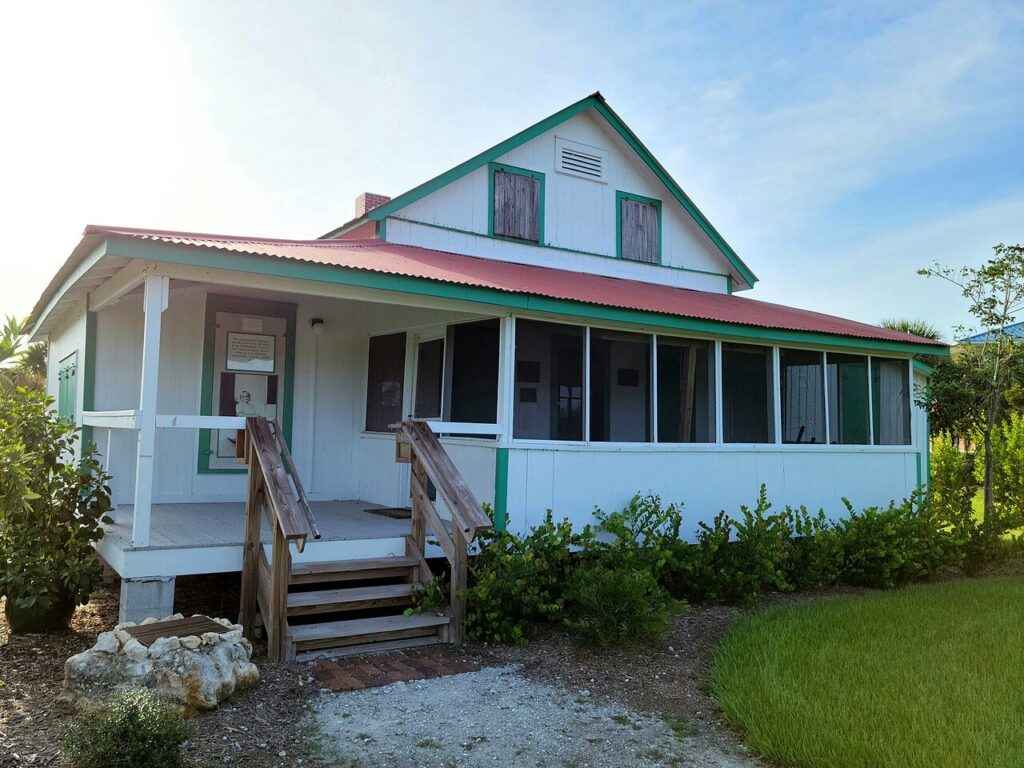
A visitor can stand at a writer’s front door in Vero Beach without standing where the writer lived. The small house associated with Laura (Riding) Jackson once occupied a citrus property in Wabasso. After her death it traveled first to the Environmental Learning Center and later to Indian River State College’s Mueller Campus. The house and the address have different biographies. Understanding both gives a visitor a better introduction to one of the county’s most idiosyncratic literary lives than a quick look at an old porch ever could.
In 1943 Laura and Schuyler Jackson moved into the frame house on 13 acres of groves. According to the foundation’s biography, the couple grew citrus and shipped it north to support ambitious work on language. That is an unusually direct local connection between fruit and literature. Citrus income helped make time for intellectual work whose subject extended far beyond Florida. The grove also mattered in a more demanding way. Fruit had to be grown and sold regardless of whether a definition or an argument had reached a satisfactory stopping point.
The author before the grove
Readers encountering the house first might imagine an author whose career started and ended on the Treasure Coast. Jackson had worked across several countries before settling here. She collaborated with the English writer Robert Graves and helped establish the Seizin Press in London in 1927. Her European years included work in Mallorca. By the time she came to Florida she had already developed a significant career in poetry. The move to Wabasso belonged to a period when she was asking difficult questions about poetry itself and about what ordinary language could be expected to do.
The change in direction was considerable. The foundation records that in the early 1940s she gave up writing poetry and turned toward studying language. One project with Schuyler began as a dictionary in which a word would receive a single definition. Try that experiment with an ordinary word such as “home.” It can name a building, a place of origin, a household or the destination after a journey. Even selecting an example raises questions about which meanings overlap and what counts as a distinct use. An intriguing part of visiting this particular writer’s house is that the house itself makes an excellent word problem.
Reading the structure from the inside out
The foundation’s account of the home dates its original construction to around 1910, well before the couple moved in. The oldest central portion is Florida pine. Deep porches and windows arranged to admit a cross breeze are among the features the foundation identifies with the vernacular style often called Florida cracker architecture. The Jacksons added a bedroom and bathroom and installed indoor plumbing. Consider those layers before describing the place as a building frozen in the year of construction. An occupied home changes as the requirements and preferences of its occupants change.
Laura lived there without electricity until 1989, according to the foundation, using kerosene for light and heat and propane for cooking. Those details are often treated as a gauge of simplicity. They are more revealing as a description of specific choices about household systems. Cooking, lighting and heating needed different provisions; the indoor plumbing belonged to another system again. A house can gain one convenience without acquiring all the others at once. Reading about those decisions beside the authors’ sustained intellectual labor also discourages an easy assumption that a technologically modest home implies a narrow view of the world.
Why the preservation dates matter
Jackson died in 1991. A group interested in keeping the house formed the preservation foundation in 1992. In August 1994 the structure was moved to the Environmental Learning Center. In July 2019 it moved again to the Mueller Campus. These are useful dates to keep attached to any picture of the house. A photograph taken at the learning center is an authentic photograph of the building, yet the grounds visible around it belong to a different chapter from the years among the Wabasso citrus trees.
There is a practical use for that distinction when browsing old photographs with a relative. Ask about the location of the camera before trying to date a roof repair or a planting from the view. A background tree, a path or an open stretch of ground may identify which site you are seeing more readily than the front of the house, which traveled. On a visit today, ask which aspects of the presentation interpret the Wabasso years and which were developed to receive readers and writers at the current site. Preservation involves explaining a move as well as accomplishing it.
Take a piece of text to the house
Schuyler died in 1968. Laura carried on the couple’s language project, which eventually became a larger study. Rational Meaning appeared posthumously in 1997. A visitor need not have read the entire volume to approach the literary side of the site. The biographical page links to an audio recording of the author reading poetry and to a list of major works. Listening to a writer’s delivery is a good counterpoint to reading biographical dates. It allows a reader to hear emphasis and pace before trying to decide what to make of the later turn away from verse.
For a writing group or a family, give the visit a deliberately small task. Ask each person to select a word that describes both an object in a house and an idea that can travel beyond it. “Threshold” and “shelter” are possible starters. Write a definition, test it against a second use and decide whether the definition can hold. This is a visitor’s exercise, not a reconstruction of one of Jackson’s manuscripts. The pleasure is in discovering how quickly ordinary words become puzzling when someone asks them to carry a precise meaning.
At the end, return to the question of home. One answer lies in the pine structure preserved for visitors. A second lies in the absent Wabasso grove where two writers made a living. A third is in the work that the foundation now does to bring people together around writing. The moves separated some things that were once inseparable. They also gave generations who never knew the Jacksons a front door through which to begin thinking about the choices they made.