Pineapple slips and a teacher’s boat ride at Hallstrom Farmstead
Ruth Hallstrom’s gift preserved a brick farmhouse, a family collection and evidence of life on the Golden Ridge, where pineapples preceded citrus.
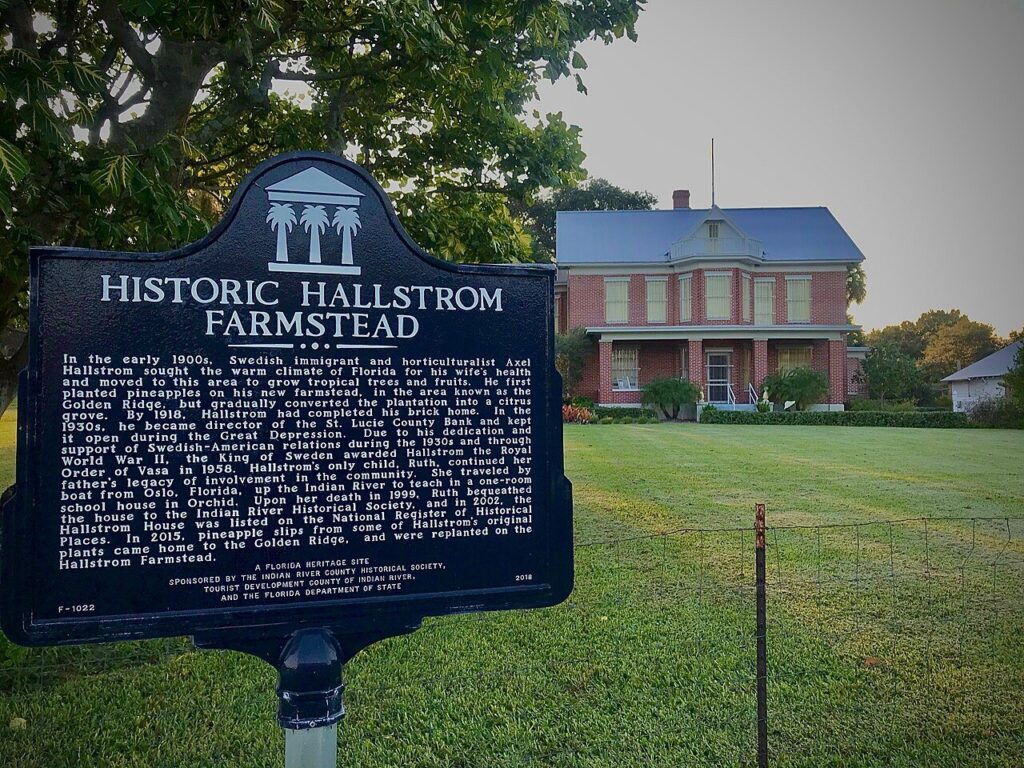
A pineapple is an unlikely family document until you know where it came from. The historical marker for the Hallstrom Farmstead records that in 2015 slips descended from some of Axel Hallstrom’s original plants were brought back to the Golden Ridge. A century after the early planting, people could connect living material to the story of a particular farm. On the same site, family furniture and photographs preserve connections of a different kind. The house survives because Axel’s daughter Ruth decided that other people should be able to read these things together.
The Indian River County Historical Society operates the house at 1723 Old Dixie Highway SW. It describes a five-acre bequest with a house, outbuildings, contents and grounds. Indian River County acquired and restored more than 100 adjoining acres as a nature preserve and green space. A house museum and a neighboring preserve offer two ways to approach this piece of southern Indian River County. Neither one alone gives a complete account of a family that grew fruit, taught school, did business and kept ties well beyond the county line.
A fruit farm that changed crops
The Florida historical marker identifies the early farming area as the Golden Ridge. Axel, a Swedish immigrant, grew pineapples before gradually converting the farm to citrus. The brick house was complete by 1918. It is tempting to picture one fixed scene around that date, perhaps a house with an immaculate grove in the background. The sequence in the record is more instructive. A durable building occupied ground where the productive landscape could change over the life of a single family. The fruit most closely associated with Indian River County today was only part of the land’s agricultural history.
The historical society traces an earlier leg of Axel’s journey to Minneapolis in 1898 before he and Emily Hallstrom moved to Florida seeking a warmer climate for her health. Those places matter in a house often described simply as a pioneer home. The family arrived with experience and connections from elsewhere, then made decisions in response to conditions here. The marker also records that Axel eventually directed the St. Lucie County Bank and received a Swedish honor in 1958. Neither detail is visible from the outside of a farmhouse. Both give some sense of the reach of a life conducted from it.
Ruth had a route of her own
The most vivid piece of geographical evidence may be a journey rather than an object. The state marker says Ruth Hallstrom went by boat from Oslo up the Indian River to teach at a one-room schoolhouse in Orchid. Trace the two places on a map before trying to imagine her commute. Viewed from a modern road, those are separate communities at different points on the coast. Viewed from the water, they belong to the same corridor. No precise schedule for her trips follows from that fact, but the route reveals a practical connection a present-day motorist can easily miss.
That teaching journey is a reason to resist treating Ruth only as the person who inherited her father’s belongings. Teaching linked her to pupils and families beyond the farm. Preserving her childhood home at the end of her life linked it to an even larger public. She died in 1999 and the society took possession in 2000. National Register listing followed in 2002. Acquisition, stewardship and recognition happened at different times and accomplished different things. The original gift is what allowed the physical collection to stay connected to the house.
What the contents add to the walls
At many old properties, the building and its furnishings arrive at the museum by different paths. The society describes the Hallstrom collection as including photographs, papers, furniture, artifacts and personal memorabilia. The survival of several kinds of evidence offers unusual possibilities. A room can establish relative size. A photograph can establish that a piece of furniture once stood in a particular place, provided someone knows where and when the picture was taken. A letter can identify a sender or recipient that a photograph left anonymous. One type of evidence can put sensible limits on what you infer from another.
On a tour, ask which things have remained in the house, which have been moved for display and how the museum knows their history. An object need not be in its original position to be valuable. A sewing tool displayed for a visitor today may make an activity more understandable than it would sitting in the back of a closed drawer. It is still useful to distinguish the position chosen for explanation from the position familiar to its owner. A guide’s answer can change how much you learn from the next room as well as the one you are standing in.
A museum and a preserve next door
The five-acre gift and the larger county property raise another question about scale. A visitor can travel to the correct part of the county and still confuse an outing to a preserve with admission to a house. Consult the society for its current docent-led tour arrangements and the county for outdoor access when planning both. If the house is your priority, use the historical society’s visitor address. A historical marker pin locates an interpretation panel; it need not identify the entrance where a group is expected to assemble for a visit.
A family could give younger visitors the job of keeping the two kinds of history in view. Ask them to choose something that could have been put in a moving box and something that could only have been saved by preserving the place. A photograph travels. A route from the house to an outbuilding, or the relation of the farmhouse to surrounding land, does not. Pineapple slips complicate that division in an interesting way. They traveled, reproduced and returned. The living connection depends on people keeping track of their origin, just as a paper archive depends on people keeping the names on its photographs.
The house can be appreciated as architecture. Its most generous contribution to local history is the chance to go further. Follow a crop through its replacement and return, a teacher through her journey on the lagoon and a daughter through her decision about what should happen to a home. Those three threads reach well beyond the front door. Together they explain why an ordinary visit to a house on Old Dixie Highway can change how the wider Indian River landscape looks on the ride home.