At McKee, a 35-foot board came before the building
Three structures at McKee Botanical Garden tell different stories about design in Vero Beach, from Waldo Sexton’s table to an engineered bamboo pavilion.
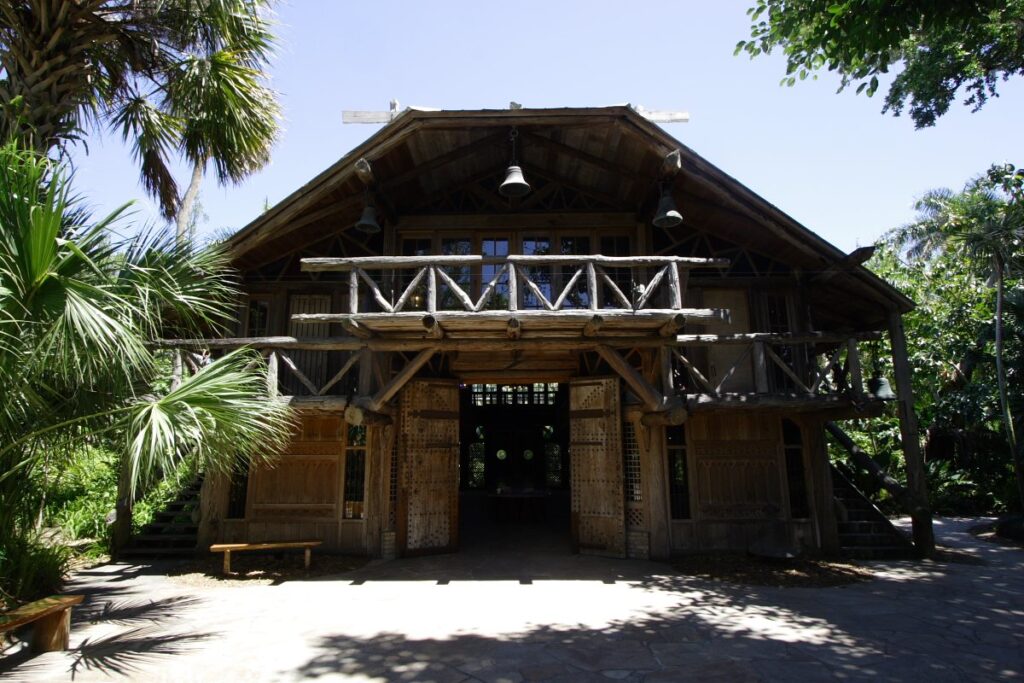
Most rooms are designed first and furnished later. At McKee Botanical Garden in Vero Beach, the account runs the other way around. A single board of kalantas mahogany, roughly 35 feet long, was the reason to build the Hall of Giants. Garden co-founder Waldo Sexton had encountered the timber long before it arrived in Florida. The question was what to do with a piece of wood so large that an ordinary room would have made an absurd setting for it. His answer was to make a hall equal to the table.
That is one way to enter a garden known for plants. Instead of counting species, follow three structures whose makers had different ideas about what a building in a tropical garden ought to do. One presents an astonishing object. A second supplied meals for groups. The third treats a plant itself as a structural material. Together the Hall of Giants, Spanish Kitchen and Bamboo Pavilion give even a visitor who cannot name a single palm quite a lot to see.
From a fairground to a Florida garden
McKee’s architectural history traces the table timber to the Philippines and Sexton’s encounter with it to the 1904 World’s Fair in St. Louis. The garden says he followed its movements for decades before bringing it to Florida in 1940. The hall went up in 1941. Three dates belonging to one piece of wood stretch the story across two continents and most of a working lifetime. For a Vero visitor, that chronology undercuts an easy assumption that everything in an old Florida attraction must have come out of the surrounding landscape.
The garden recounts that Sexton outlined his idea in the sand. It describes the building as inspired by Polynesian design. Those details help explain the character of the space, but the local history is more interesting than a simple story of style. A plank with a known length imposes real conditions. The room has to receive it, permit people to approach it and leave enough space for a viewer to appreciate the difference between a 35-foot slab and a collection of ordinary tables. Consider where you would stand to show its scale in a photograph without anyone touching it. The answer tells you something about the building as a frame.
A room that makes sense through a meal
A table as a spectacle is one thing. Feeding a gathering is another. The adjoining Spanish Kitchen, also designed by Sexton in 1941, supplies the social half of the story. McKee links its design to Mexican fiesta kitchens and identifies painted tile, iron kettles and a central grill. The garden records gatherings here that ranged from gospel singers to spring-training picnics involving the Dodgers. That range matters more than the oft-repeated number of steaks the grill was supposed to handle. An attraction remembered for luxuriant vegetation could also work as a place where Vero groups met one another.
Try looking at the kitchen through a sequence of actions. Someone must bring ingredients to a cooking space, tend heat, move a finished dish and find a place for people to gather. Identify which of those actions the published description supports and which would require a plan or an account from someone who worked there. A row of heavy kettles gives direct evidence of provision for quantity. It cannot tell you what any particular team ate on any particular afternoon. A visitor who keeps those two levels separate gains both a better picture of the room and a much better question for a guide.
The building almost lost along with the garden
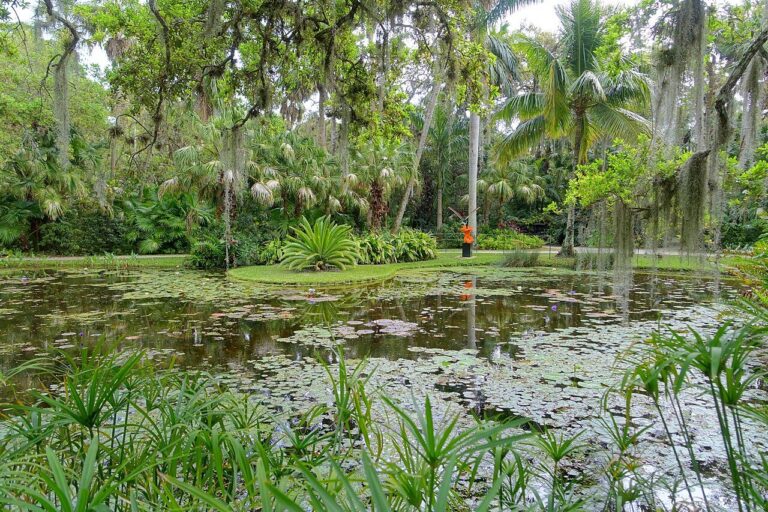
The setting around those two buildings has changed dramatically. McKee’s institutional history dates the founding of McKee Jungle Gardens to 1932, identifies Arthur McKee and Waldo Sexton as its founders and credits landscape architect William Lyman Phillips with the design. The attraction occupied about 80 acres. After it closed in 1976, most of that land was developed. The surviving 18 acres eventually faced the prospect of further development. The garden connects their rescue to the Indian River Land Trust and the Trust for Public Land and records its reopening in 2001.
Those numbers change what the present landscape means. A visitor is walking through part of a once much larger attraction, in a garden restored for a new purpose. An old room seen beside new planting does not by itself tell you how that view looked when the table arrived. Conversely, newer construction is part of a real chapter in McKee’s history. The difficult feat was preserving enough land and enough of its identity to let a living institution make new decisions. An account that stops with Sexton misses that work by several decades.
Bamboo, this time as engineering
The Bamboo Pavilion belongs to the years after reopening. Completed in 2002 and designed by Jörg Stamm, it uses Guadua bamboo from the Andean region. McKee identifies a combination of Andean construction practices and European joinery. In the hall, a remarkable piece of timber is the object to look at. Here the plant material is doing the supporting. To appreciate the difference, look where one stem meets another and follow the line toward the ground. Even without engineering training, one can ask where the weight appears to go and which intersections seem to do more than one job.
The pavilion also repays a second glance at the way a public garden labels objects. A plant label usually supplies a biological name and perhaps a geographic origin. A building might carry the name of an architect and a year. In this case all of that information belongs in the mental picture. Knowing the species without the architect leaves out the design work. Knowing only the architect conceals the importance of selecting and preparing material with particular dimensions and behavior. The garden’s account of how the stems were harvested and cured adds another layer to the view.
Give yourself time at the end to choose one detail from each structure, such as a table edge, a kettle or a bamboo connection. Each detail points beyond ornament to somebody’s labor. That is a good reason to return to McKee even if the flowers you most wanted to see have passed their peak. These three buildings ask questions about material, appetite and gathering that are in season whenever the garden is open.