Coffee With Car Owners or a Tour With the Curator? Two Mornings at the Elliott
The Elliott Museum in Stuart hosts free Saturday Cars and Coffee meetups and separate Thursday collection tours. Compare the times, costs and experiences.
What the Elliott Museum calls Cars and Coffee is over at the time many visitors would normally begin a museum visit. On the second Saturday of the month, owners and admirers gather in the parking lot from 8 to 10 a.m. Another motor-minded group meets on most Thursdays just before 11 a.m., inside at the front desk. Both happen at 825 NE Ocean Boulevard in Stuart. One is an open conversation among people who brought their vehicles; the other is a chance to explore a museum collection with its curator or an assistant. The distinction is worth the drive across the causeway.
The Historical Society of Martin County lists Saturday, December 12, 2026, among the car meetups, with another on January 9, 2027. It lists Thursday garage tours including December 3 and 10, while asking visitors to telephone to confirm before coming out. Those two kinds of date lead to entirely different invitations. A friend hoping to show you a car they restored belongs in the Saturday plan. A visitor chiefly curious about how a museum displays dozens of vehicles indoors may want to set aside a weekday morning. Historical Society of Martin County car events and calendar
The Saturday conversation starts with a vehicle somebody drove
The museum describes Cars and Coffee as free and open to everyone. Visitors can bring a vehicle to show or simply arrive to look and talk. The event page lists a $4 refreshment option for coffee, doughnuts and ice water. Admission to the outdoor gathering is separate from buying something to eat and from any subsequent indoor museum visit. A pair of friends can therefore agree to meet for an hour before breakfast without committing to a whole museum day. December Cars and Coffee event details
A first-time visitor may find that the most approachable car is one that reminds somebody in the group of a family vehicle. Ask what the owner likes about actually driving it. A large steering wheel can start a conversation about turning at low speed. A long door can start another about parking garages. An owner may have very particular opinions about which details would be worth changing and which they have worked hard to keep. The car is a piece of design, but the person who has to fit it into an ordinary Saturday brings a different kind of knowledge to the discussion.
Try a second conversation with a vehicle you cannot immediately identify. Notice something specific before asking a question. How does the hood open? Where does a passenger put a bag? Can someone see the front corners of the car from the driver’s seat? These are everyday questions even a child who knows nothing about model names can ask. They make it possible to compare vehicles across decades without pretending to understand an engine you have only just seen. Let the owner offer to open a door or show a detail before reaching toward the car.
The current public event listing explicitly calls Cars and Coffee a rain-or-shine gathering, with refreshments moved inside if needed and visitors encouraged to come in their ordinary cars in poor weather. That is a useful distinction for anyone driving from Vero Beach hoping to see one particular kind of classic. An event can still go ahead while the mix of cars changes. If what interests you is the largest possible outdoor display, it may be worth choosing another second Saturday. If you chiefly want to meet the people, an overcast morning can still serve the purpose.
Thursday brings the collection into focus
For the auto collection and garages tour the museum asks visitors to meet at the front desk at 10:55 a.m. for an 11 a.m. start on most Thursdays. The program is included with regular admission and free for members. Its listed leader is car curator Jim Ferrare or one of his assistants. Call 772-225-1961 to confirm the specific date. Five minutes may sound like little difference until a group has left the desk while the last visitor is still finding a parking spot. Thursday auto collection and garages tour
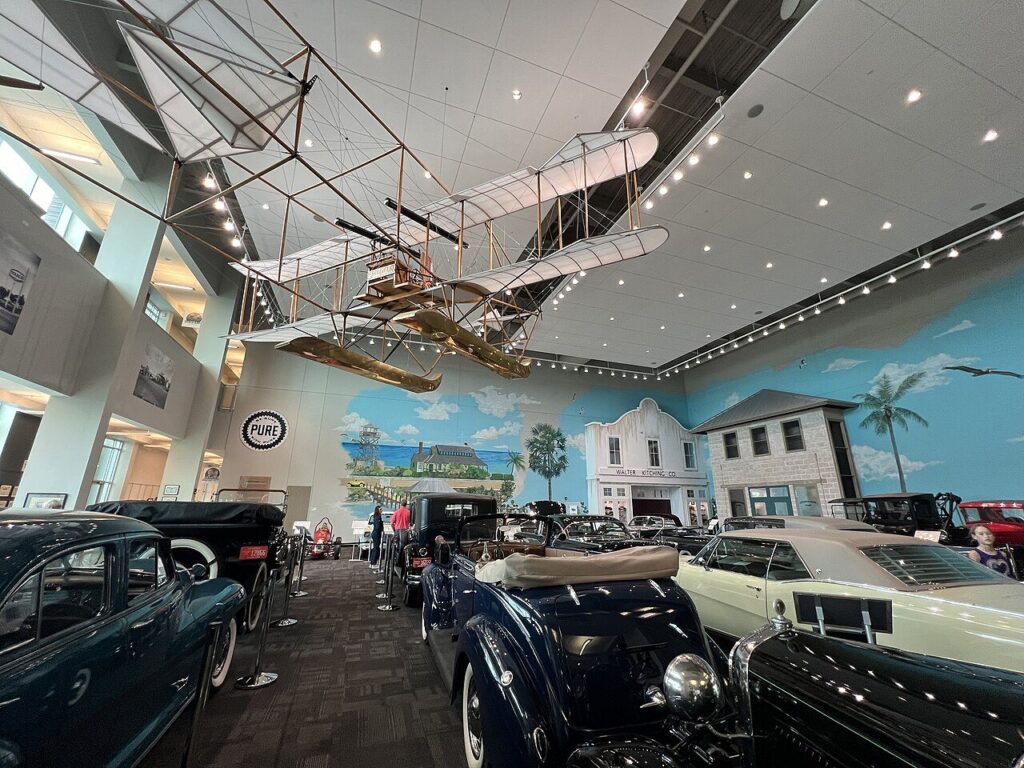
A curator faces a problem an owner at an outdoor meetup rarely has to think about. Cars take up a tremendous amount of floor space, especially when a collection represents many years and body styles. The Elliott’s answer is a three-story, climate-controlled automated storage and retrieval system that can hold around 55 cars. The historical society describes the system, incorporated into the museum that opened after the 2013 redevelopment, as a way to make a much larger collection visible within a relatively compact footprint. The means of display has consequently become an attraction in its own right.
That makes for a particularly good question to take on a tour. When a museum brings one car forward, what can a visitor see that a dense parking area would hide? The silhouette may be easier to read against a quieter background. The relationship between the height of the windows and the depth of the body may become clearer. At the same time, designers have to think about keeping vehicles accessible for care, protecting them indoors and telling a story that does more than list production years. A collection is continually being interpreted, even when everything in it looks motionless.
The museum describes an automotive collection of roughly 90 cars and trucks and also identifies vintage motorcycles and bicycles among its transportation holdings. Someone who came with a relative interested only in cars may discover an entirely different route through the subject. Following how a person steers, balances, sits or carries cargo can connect a bicycle and an automobile more effectively for a young visitor than a display label full of unfamiliar mechanical terms. The museum’s garage page has a vehicle collection list for those who do want the names before setting out.
There is no need to decide which morning is better. The parking lot lets an owner tell you why a vehicle is still worth driving. The Thursday tour gives a curator the opportunity to explain why another one is still worth preserving. Hearing both answers on separate visits offers a remarkably full picture of what it means to keep an old machine alive on the Treasure Coast.